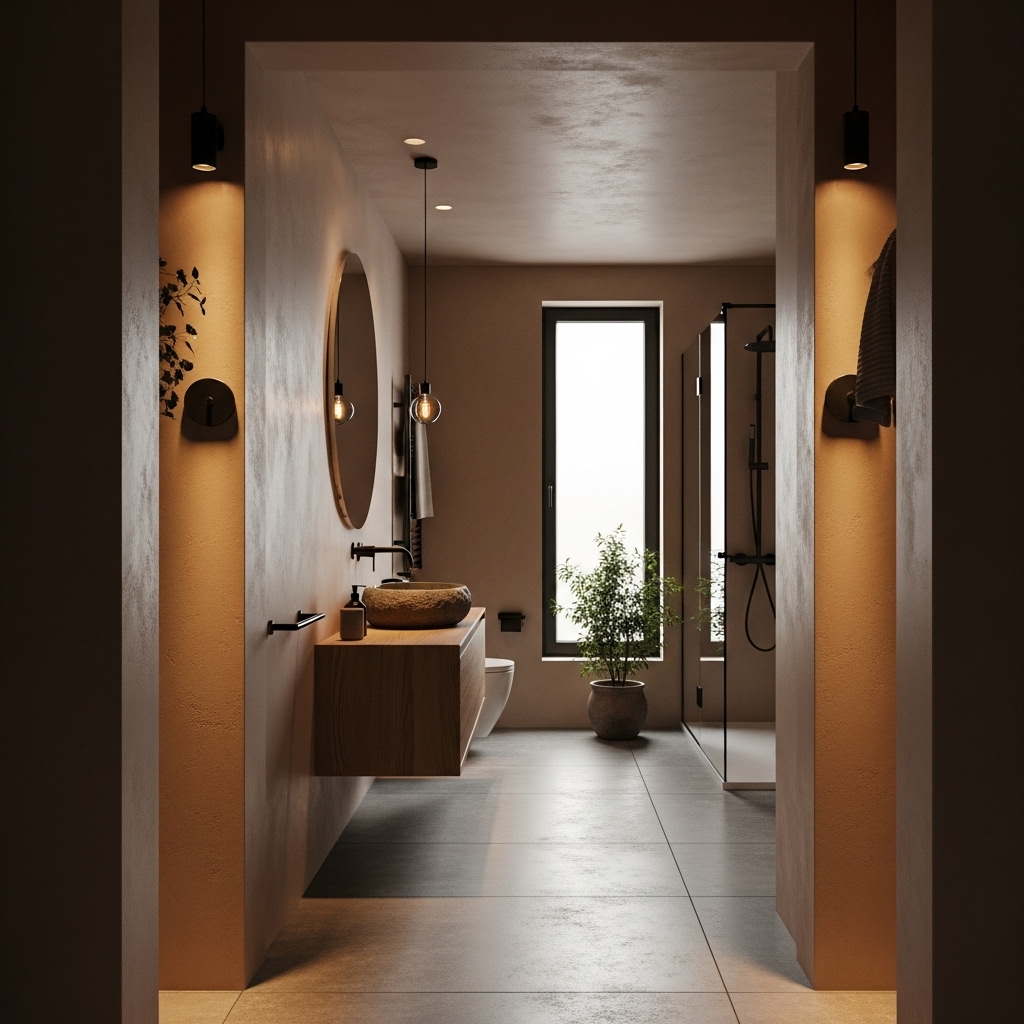
Designing Earthy Hallway Minimalist Bathrooms is about creating a “palate cleanser” for the home.
Since these spaces often transition directly from a main corridor, they should feel like a serene continuation of the hallway’s flow.
By stripping away the unnecessary and focusing on the tactile quality of raw materials, you can turn a small powder room into a grounding architectural statement.
The secret to this look is the “quiet” interaction between mineral tones and natural light.
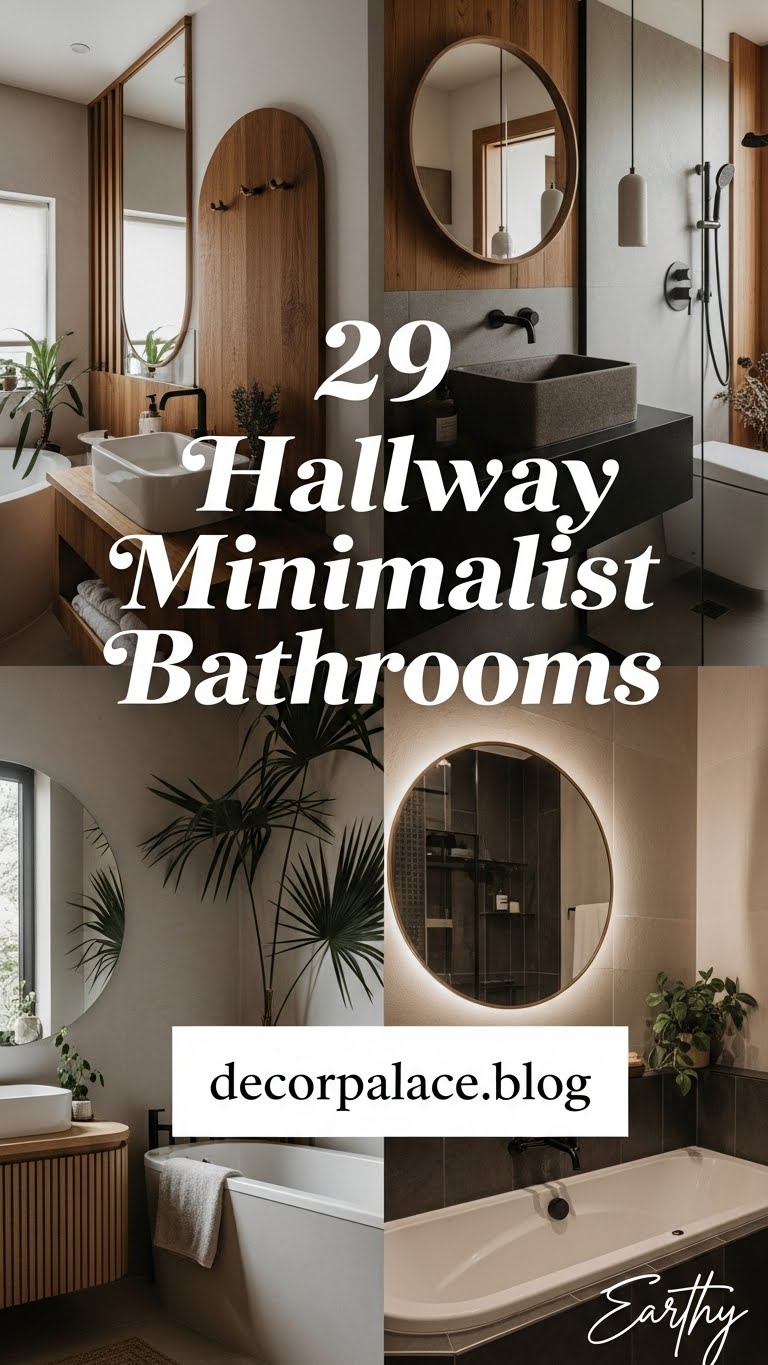
These 29 ideas focus on how to balance high-end minimalism with the rugged, comforting textures of the earth.
1#. Defining the Earthy Hallway Minimalist Bathrooms
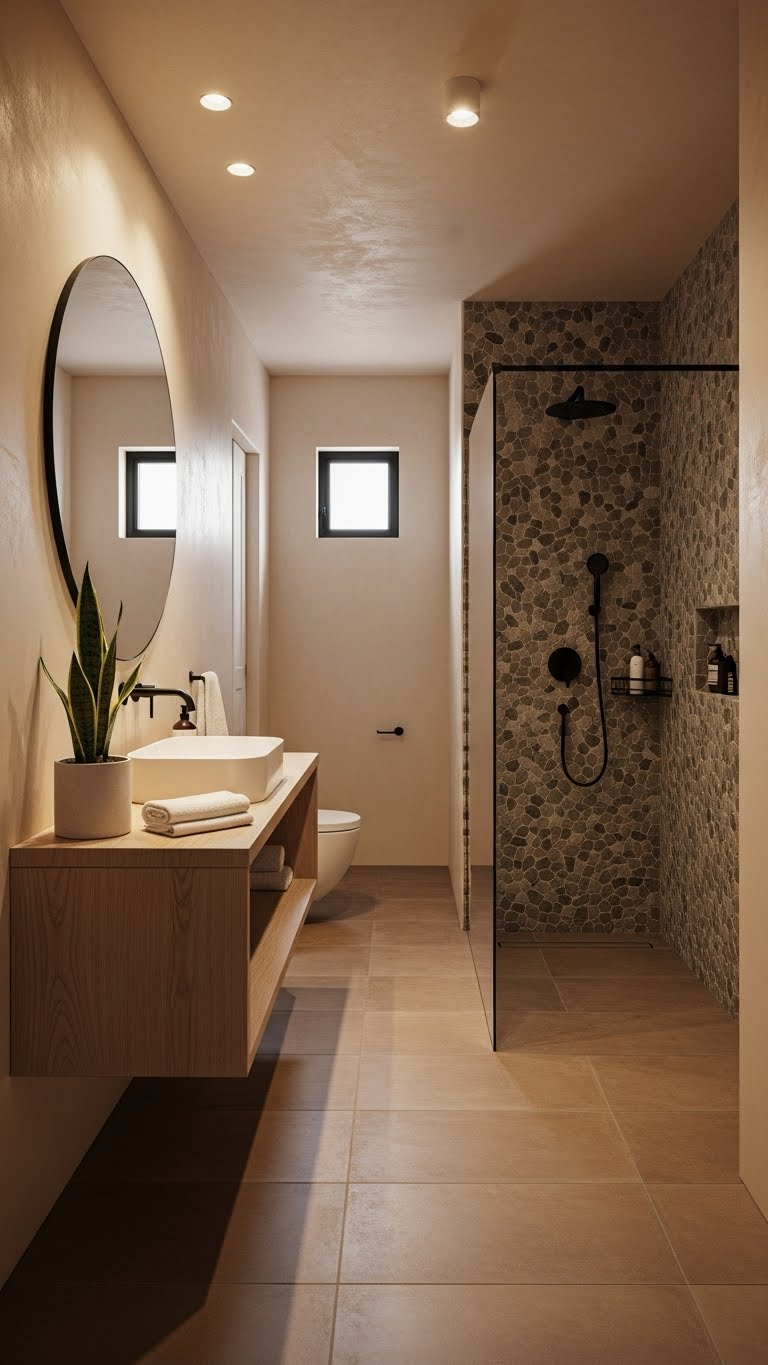
The hallmark of Earthy Hallway Minimalist Bathrooms is a curated palette that mimics the desert or a quiet forest floor. Use integrated stone sinks and wall-mounted faucets to save space while keeping the lines clean a
nd the surfaces entirely uncluttered.
This aesthetic bridges the gap between the functional hallway and the private sanctuary, ensuring no jarring transitions in your interior design.
Focus on a single “hero” material, like a limestone wall, to provide texture without overwhelming the limited square footage available.
2#. Incorporating Seamless Microcement Finishes
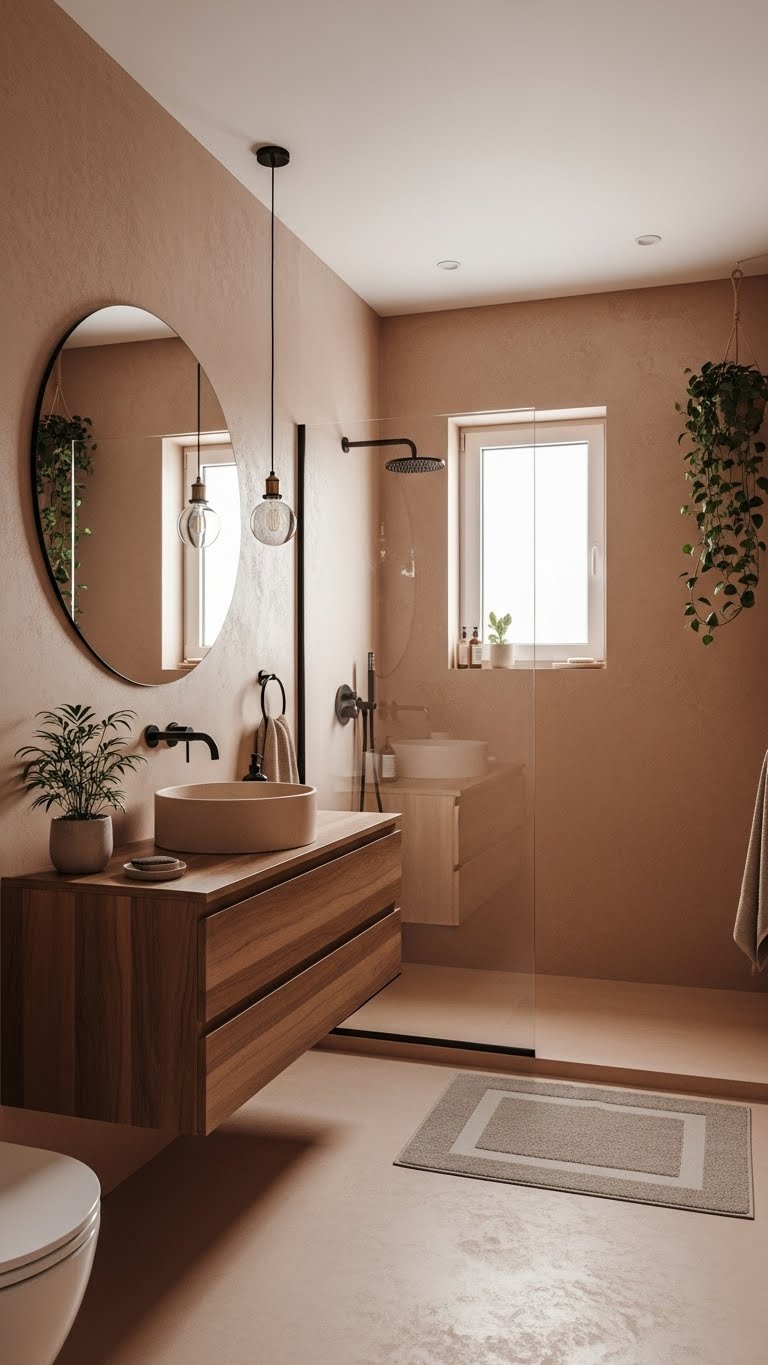
Microcement is an ideal choice for Earthy Hallway Minimalist Bathrooms because it creates a continuous, joint-free surface from the floor to the walls.
This mineral-based coating offers a soft, bone-colored aesthetic that feels incredibly modern yet grounded in the simplicity of raw concrete.
The lack of grout lines makes the room feel much larger and provides a sleek, monolithic backdrop for a simple wooden stool or a single plant.
It is a highly durable and water-resistant finish that perfectly captures the “quiet luxury” of a minimalist, earth-centered retreat.
3#. Utilizing Floating Oak Vanities
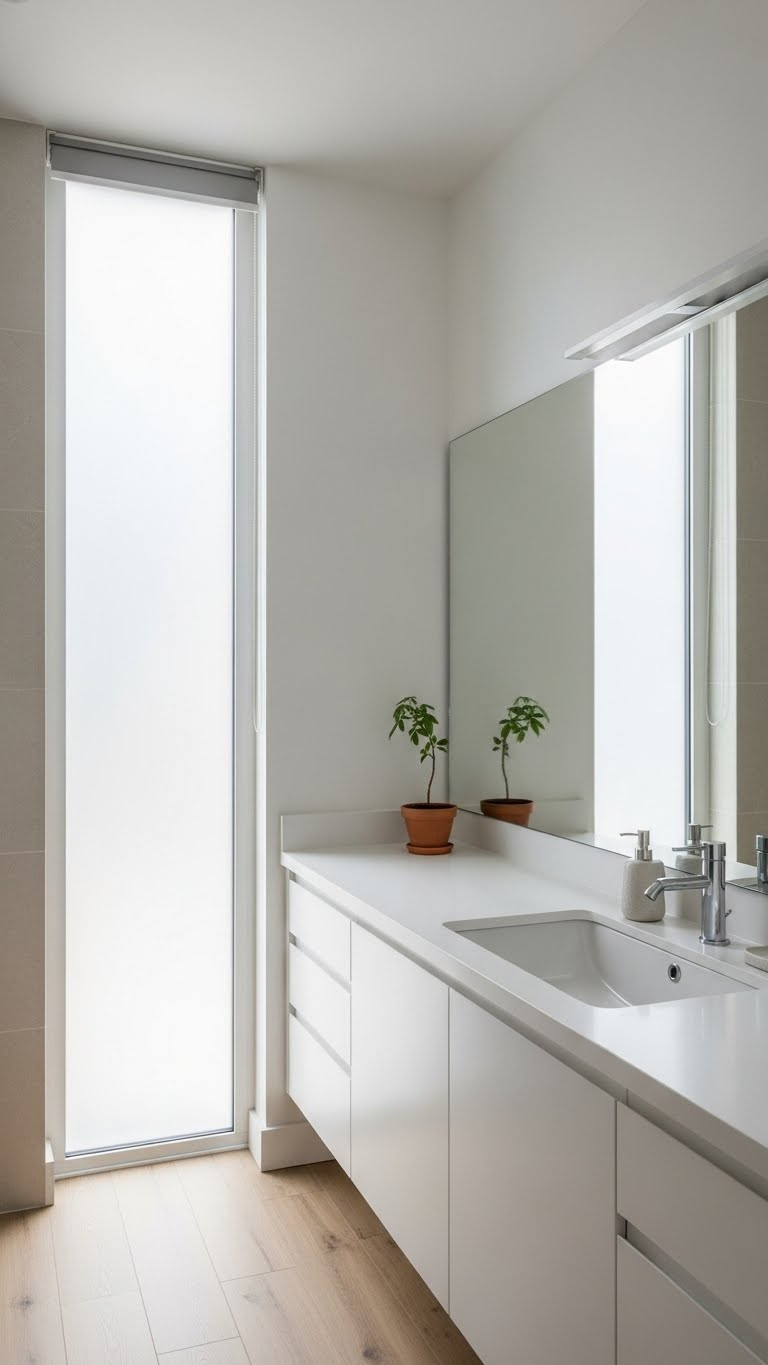
A floating vanity made from light oak adds a touch of organic warmth to Earthy Hallway Minimalist Bathrooms without taking up valuable floor space.
The elevated design allows light to pass underneath, which is essential for keeping narrow hallway-adjacent bathrooms feeling airy and bright.
Choose a handle-less design with mitered edges to maintain a sharp, contemporary silhouette that honors the natural grain of the wood.
This piece serves as a functional sculpture that provides necessary storage while reinforcing the room’s connection to the natural world.
4#. Designing with Hidden Timber Pocket Doors
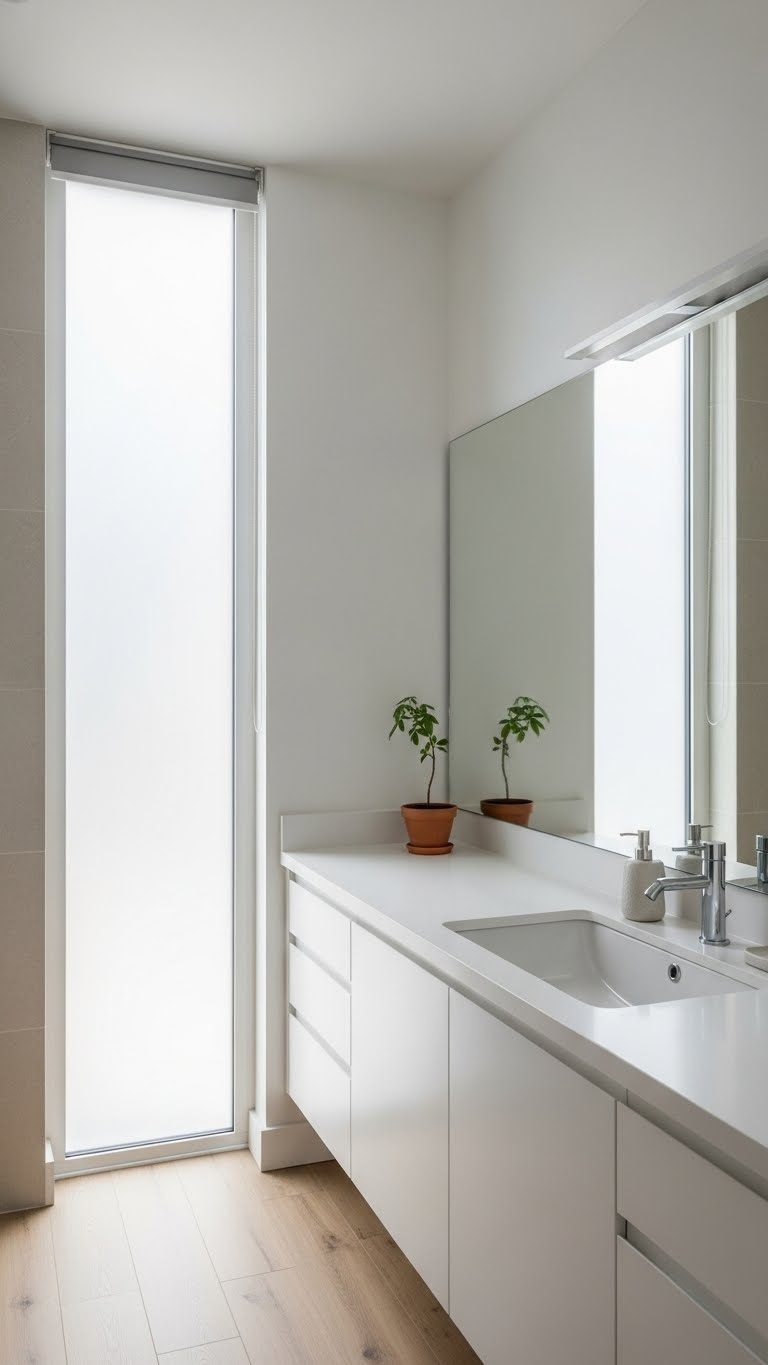
To maximize the flow of Earthy Hallway Minimalist Bathrooms, consider a wooden pocket door that disappears into the wall.
This architectural choice saves the “swing space” required by traditional doors, which is essential for keeping the transition from a narrow hallway feeling open and unencumbered.
Crafting the door from a warm timber like walnut or white oak adds a vertical layer of texture that contrasts beautifully against minimalist stone interiors.
When partially closed, the door acts as a textured wall panel; when open, it allows for a seamless, “no-threshold” look that makes the bathroom feel like a natural extension of the corridor.
5#. Installing a Monolithic Stone Pedestal
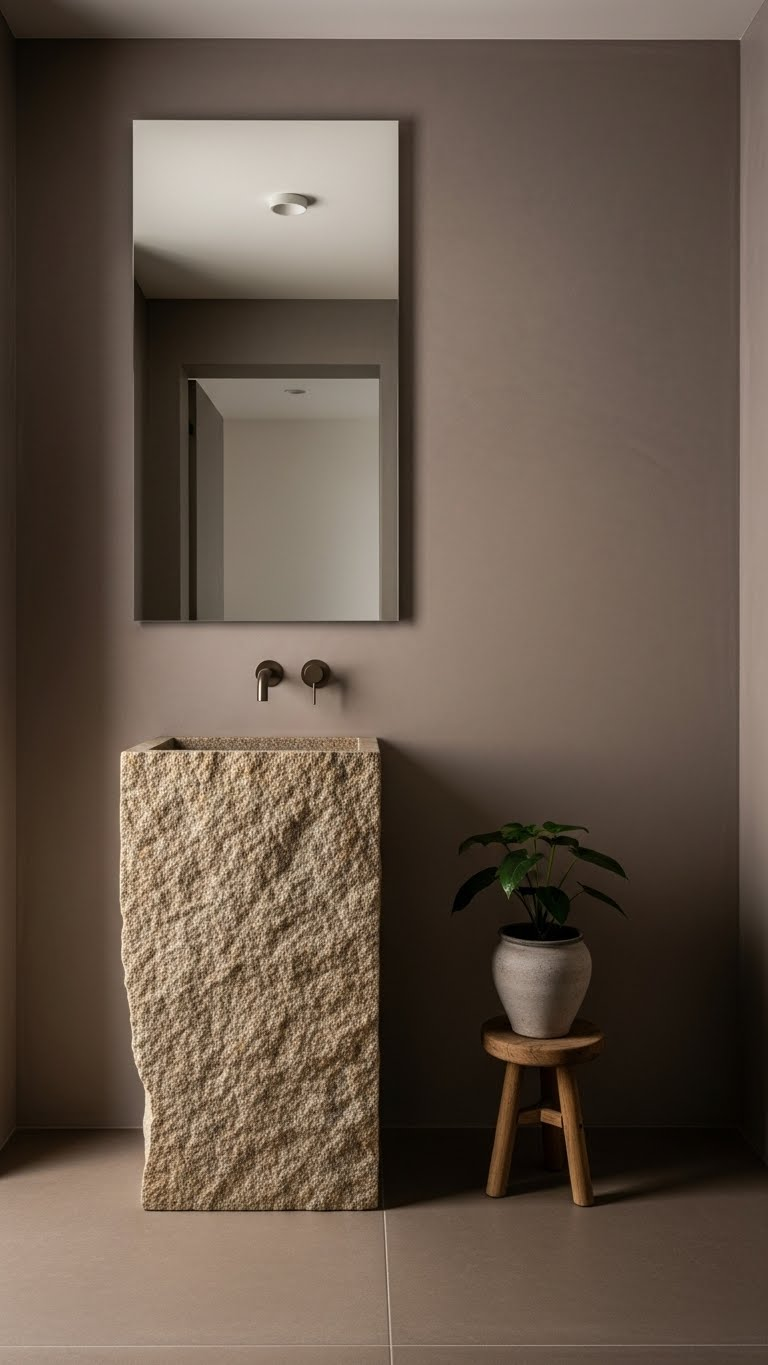
In Earthy Hallway Minimalist Bathrooms, a heavy pedestal sink carved from a single block of travertine or basalt creates an immediate focal point.
Because the sink stands alone without a bulky cabinet, it preserves the floor space, making the room feel open and intentional.
The raw, unpolished exterior of the stone provides a beautiful contrast to the sleek, modern hallway just outside.
This “sculptural” approach to plumbing fixtures ensures that even the smallest room in the house feels like a high-end gallery space.
6#. Using Concealed “Invisible” Lighting
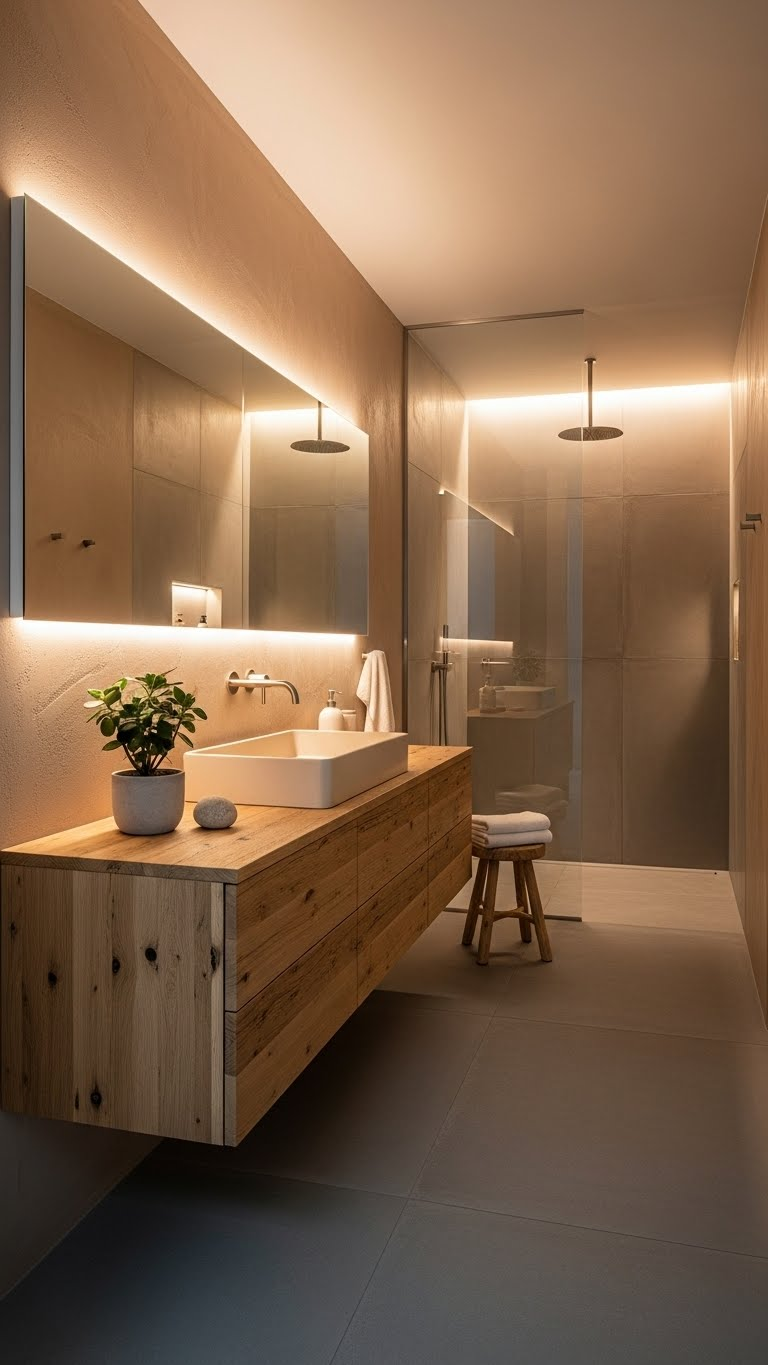
To maintain a minimalist aesthetic, avoid bulky ceiling fixtures. Instead, use recessed LED strips hidden behind a mirror or along the base of a floating vanity.
This creates a soft, ambient glow that highlights the natural grain of stone walls without revealing the light source.
In an Earthy Hallway Minimalist Bathroom, this “glow” mimics the way sunlight filters into a cave or canyon.
It provides enough light for daily tasks while keeping the atmosphere calm and restorative for guests passing through the hallway.
7#. Embracing the Warmth of Limewash Paint
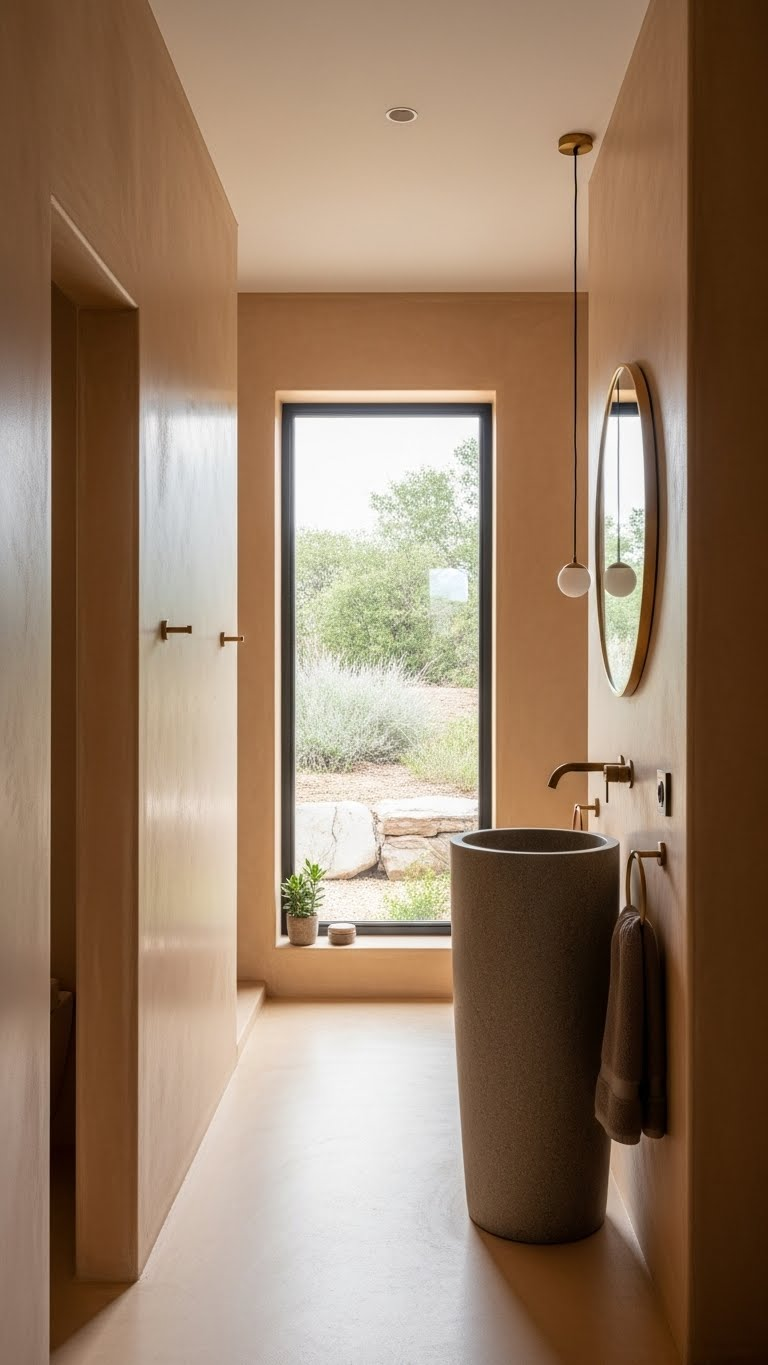
Standard flat paint can feel “dead” in a small space.
Replacing it with a textured limewash in a shade like “Morning Mist” or “Soft Clay” adds a velvety, breathable finish to the walls.
Limewash is naturally high in pH, making it mold-resistant—perfect for bathrooms.
The subtle, cloudy movement of the paint adds depth without the busyness of wallpaper.
It connects the bathroom to the hallway by providing a soft, matte transition that feels like ancient plaster rather than modern drywall.
8#. Incorporating Wall-Mounted Brushed Nickel Faucets
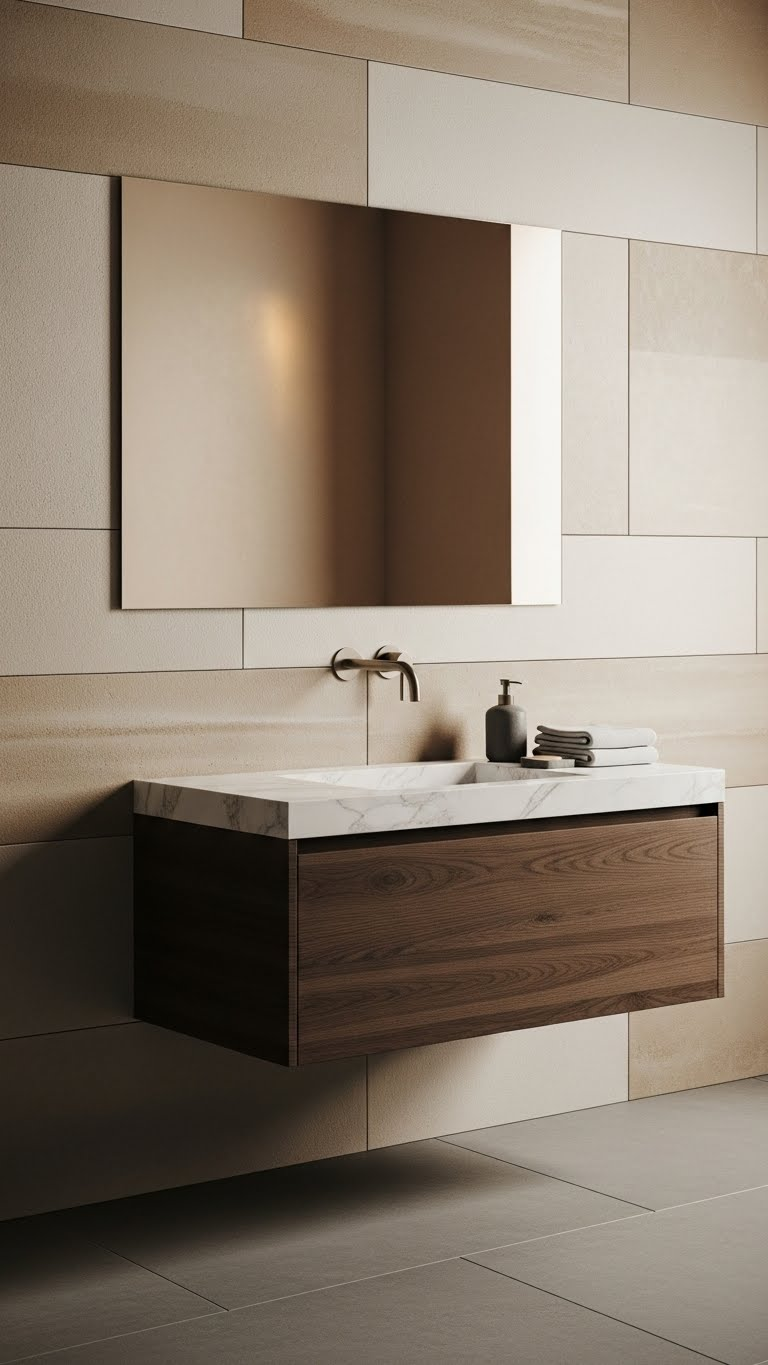
To keep your Earthy Hallway Minimalist Bathrooms looking uncluttered, mount the faucets directly into the wall.
Choosing a brushed nickel or “pewter” finish provides a soft, muted metallic look that doesn’t compete with the organic textures of the stone.
Removing the faucet from the sink deck makes cleaning easier and allows for a smaller, more streamlined vanity.
This design choice emphasizes the “minimalist” aspect of the room, keeping the horizontal surfaces completely clear of hardware.
9#. Utilizing Recessed Wood Shelving
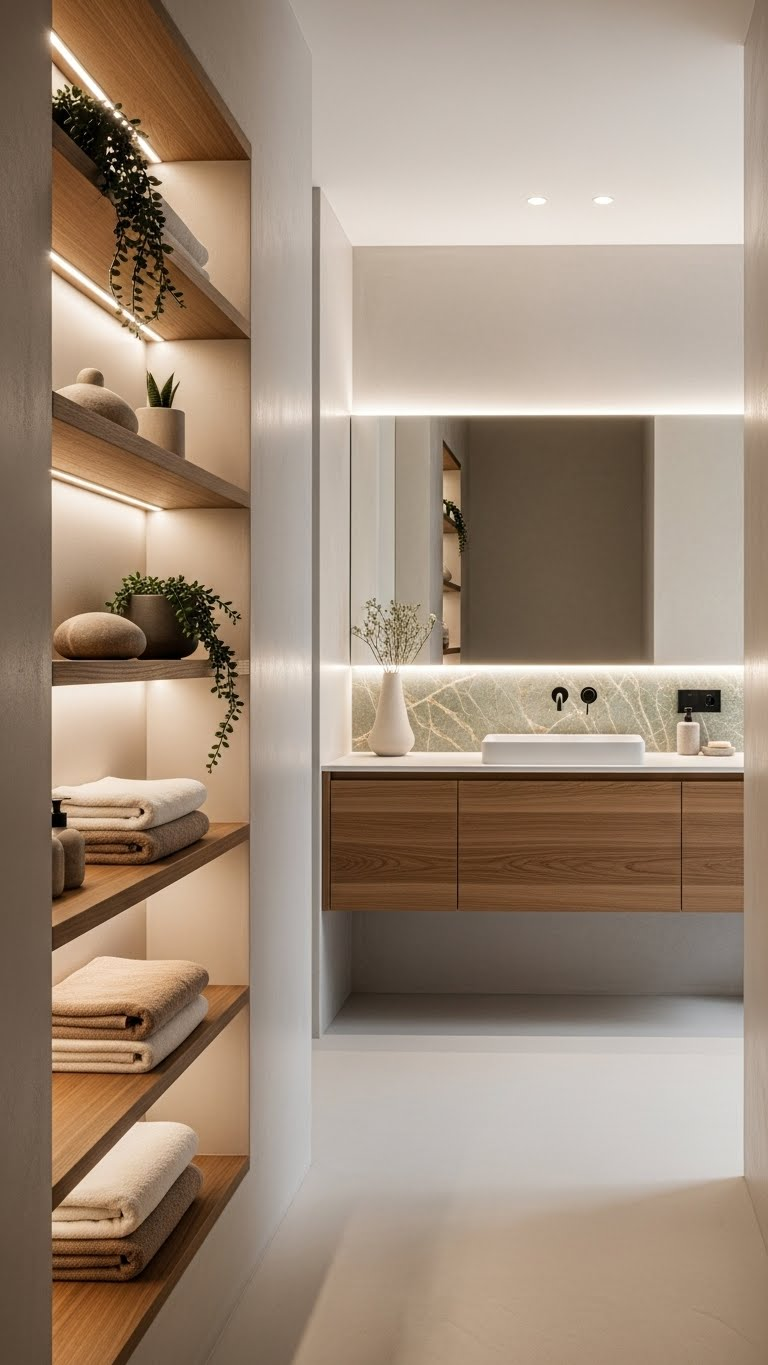
Instead of hanging cabinets that protrude into the space, carve out recessed niches lined with warm oak or reclaimed timber.
This allows you to store essentials like linen towels and artisanal soaps within the wall, maintaining a flush, clean profile.
In Earthy Hallway Minimalist Bathrooms, these wood-lined voids act as warm “windows” in a stone or plaster wall.
They provide a sense of depth and architectural interest that makes the room feel custom-built and deeply thoughtful.
10#. Adding a Single Oversized Branch
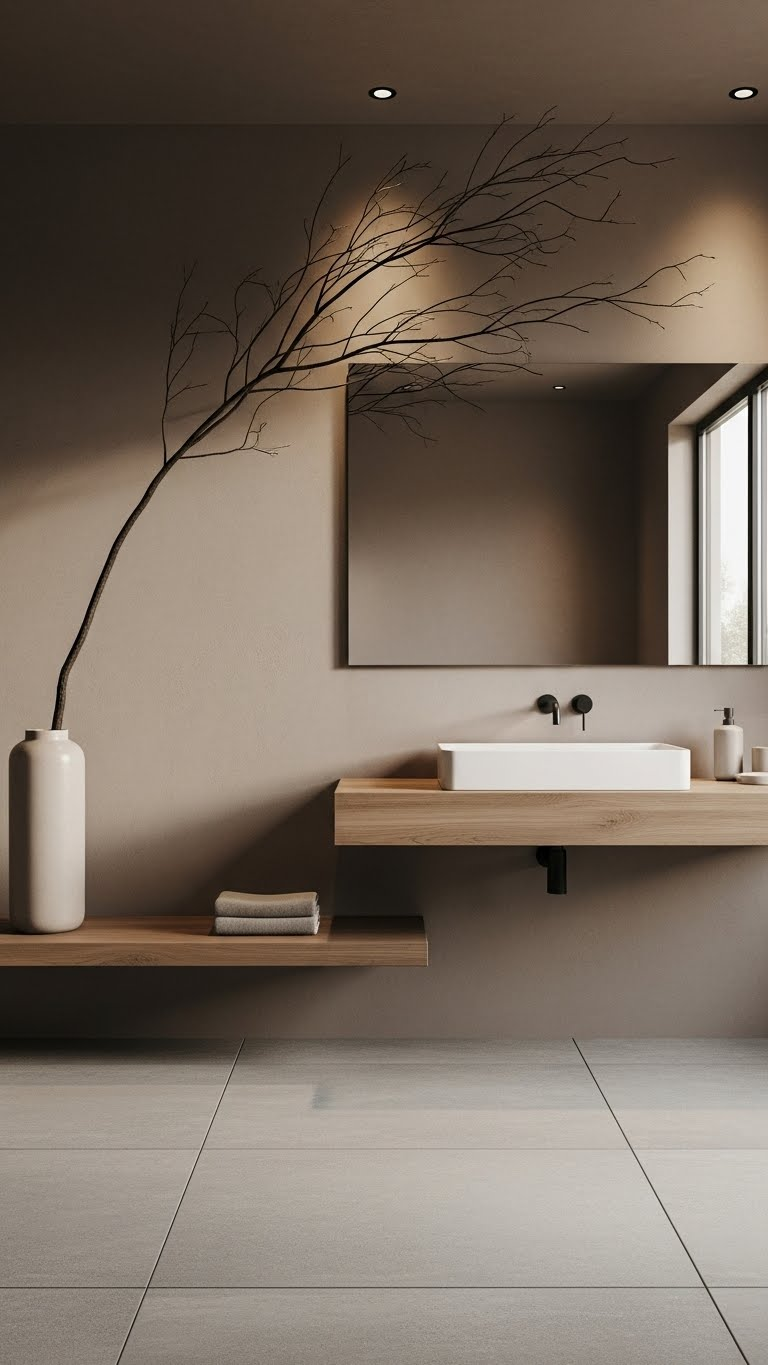
Minimalism doesn’t mean a total lack of decor; it means choosing one high-impact item.
A tall, dried eucalyptus branch or a single spray of olive leaves in a heavy ceramic vase adds a vertical, organic element that breathes life into the room.
The greenery provides a pop of color against the neutral, earthy palette of the walls and floor.
It is a simple, low-maintenance way to reinforce the “biophilic” connection that is essential for a modern, earth-centered sanctuary.
11#. Integrating Monolithic Stone Slab Backsplashes
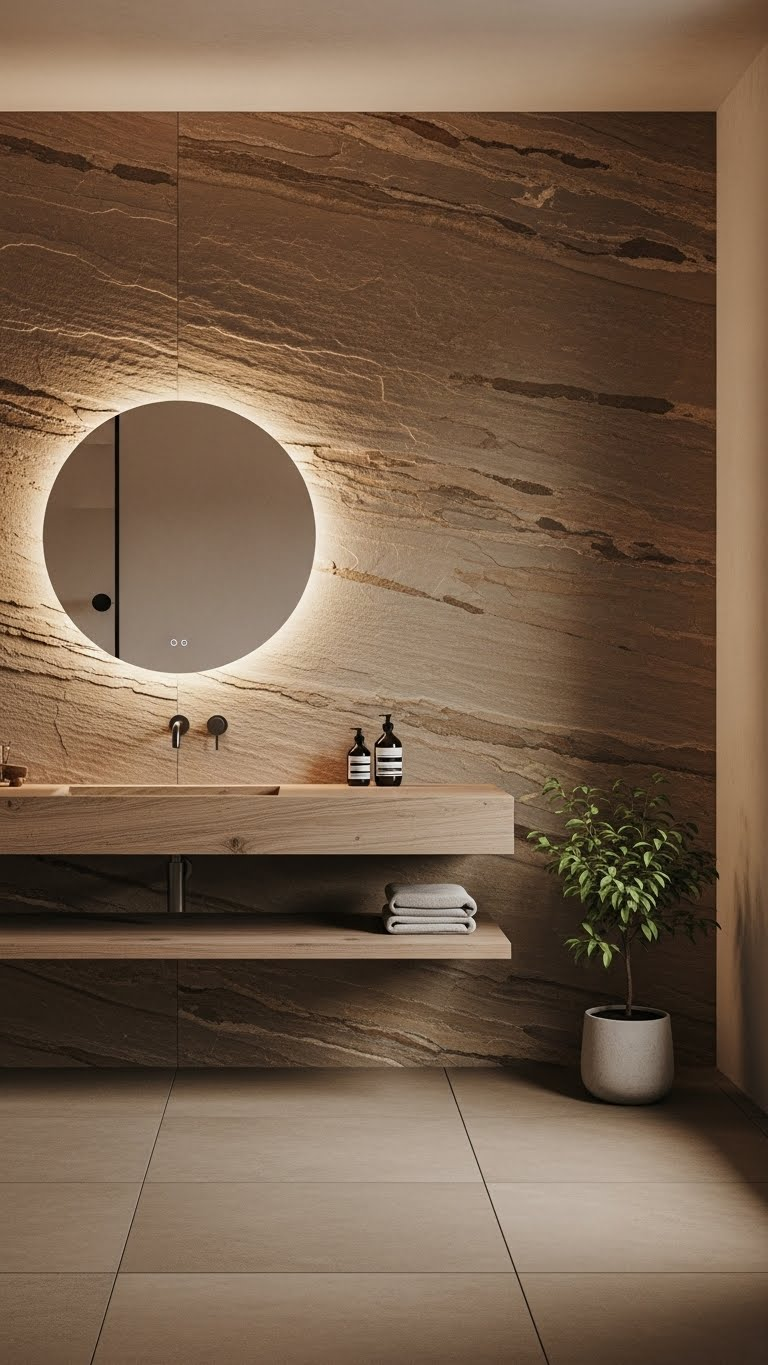
In an Earthy Hallway Minimalist Bathroom, a single, solid slab of limestone or soapstone behind the vanity creates a powerful, seamless look.
By extending the countertop material vertically up the wall, you reduce visual breaks and grout lines, which inherently makes a small space feel much more expansive and cohesive.
This “slab” approach highlights the natural, unrepeatable patterns found in the earth’s minerals, turning a functional splash guard into a piece of natural art.
It provides a clean, smooth backdrop that reflects light softly, ensuring the bathroom remains bright and tranquil despite its often compact, hallway-adjacent location.
12#. Choosing the Tactile Luxury of Tadelakt
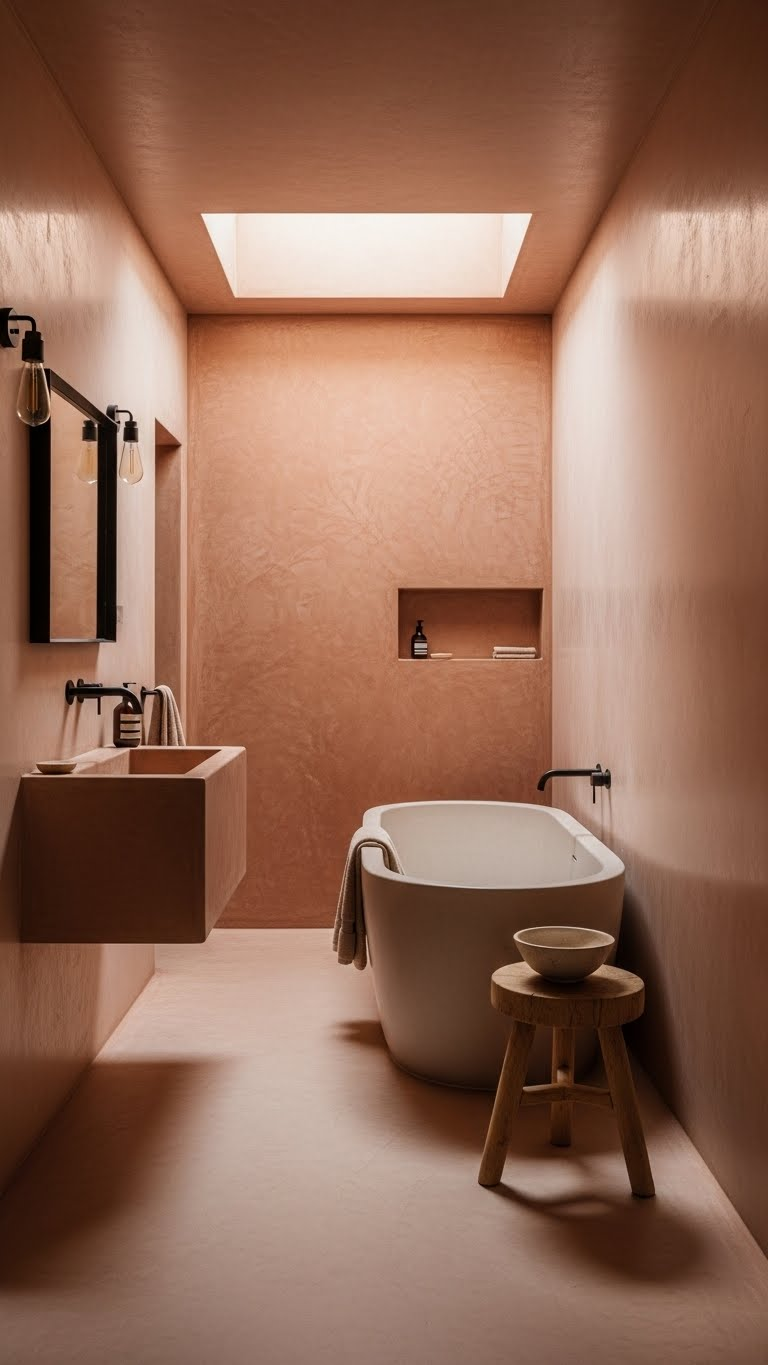
Tadelakt is an ancient Moroccan plaster technique that is naturally waterproof and entirely seamless, making it ideal for minimalist wet rooms.
Its slightly glossy, stone-like appearance is achieved through hand-polishing with a river stone, offering a tactile, handmade quality that feels incredibly luxurious yet fundamentally simple.
Because Tadelakt can be applied to curved surfaces, it allows for “soft” corners that blur the boundaries of the room, creating a cocoon-like sanctuary.
The organic, mottled finish provides a subtle depth of color that mimics the natural variations of clay, perfectly bridging the gap between high-end design and raw earthiness.
13#. Incorporating Linear Slatted Wood Ceilings
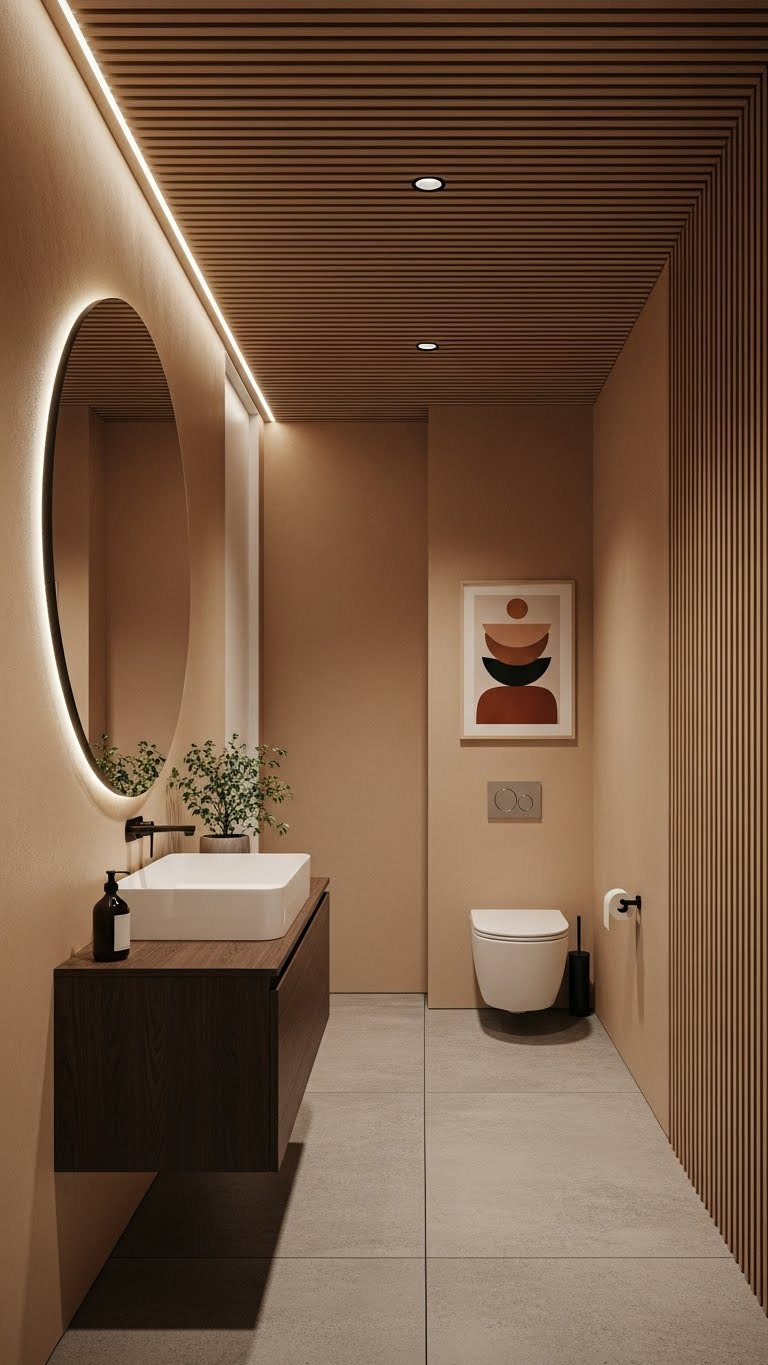
Adding a slatted oak or teak ceiling brings an unexpected and sophisticated layer of texture to a minimalist bathroom.
The repetitive linear patterns draw the eye upward, creating an illusion of height that counteracts the narrow feel of a hallway-adjacent space while adding significant architectural interest.
Beyond its visual appeal, a slatted wood ceiling provides excellent acoustic dampening, which is a practical benefit for bathrooms located in high-traffic transition zones.
The warmth of the wood overhead balances the cooler stone surfaces below, resulting in a perfectly harmonized and sensory-rich environment.
14#. Designing with Frameless Floor-to-Ceiling Mirrors
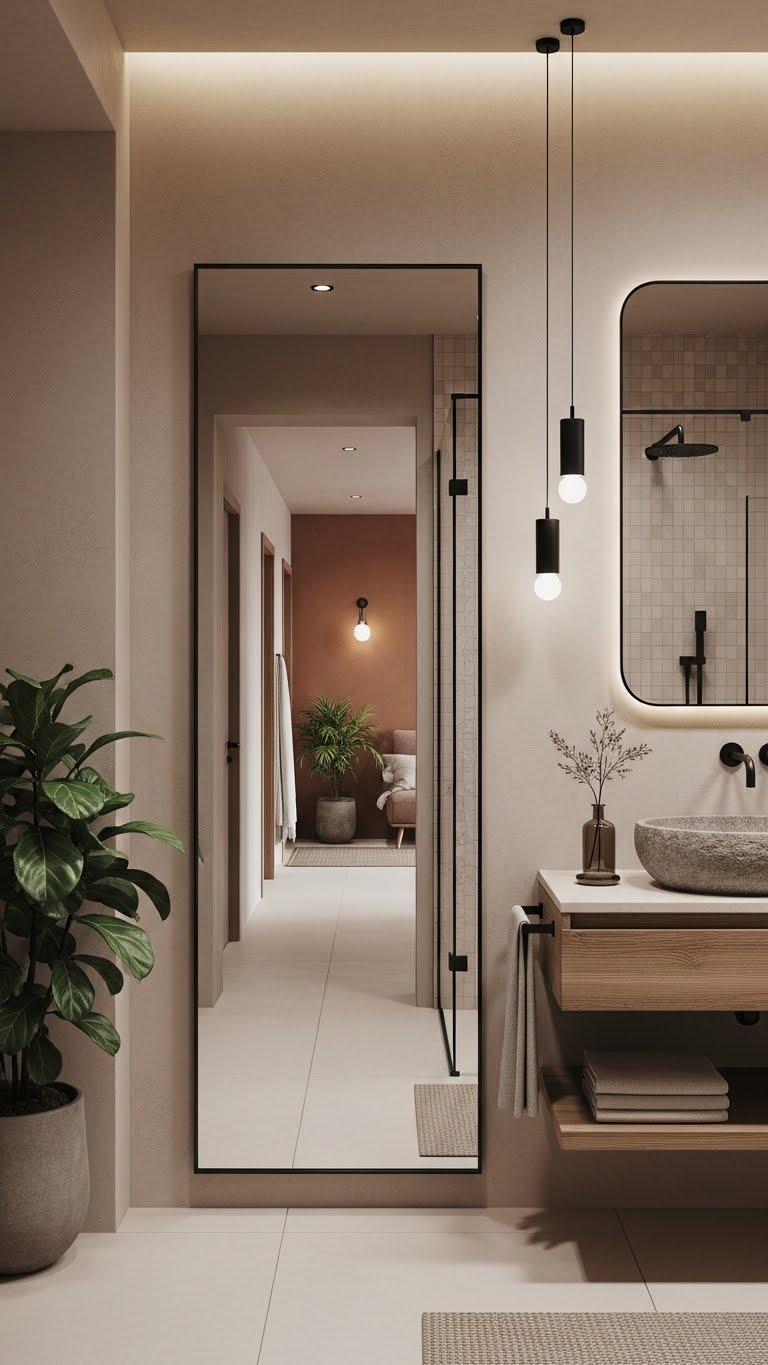
A floor-to-ceiling mirror placed at the end of a narrow bathroom is a classic minimalist trick to double the perceived visual space.
By opting for a frameless design or a ultra-slim recessed edge, the mirror disappears into the architecture, reflecting the earthy textures of the opposite wall without interruption.
This placement allows natural light from the hallway or small windows to bounce throughout the room, eliminating dark corners and highlighting the raw beauty of the stone and timber.
It creates a “infinity” effect that makes the transition from the hallway into the bathroom feel like entering a much larger, light-filled grotto.
15#. Grounding with Natural River Stone Accents
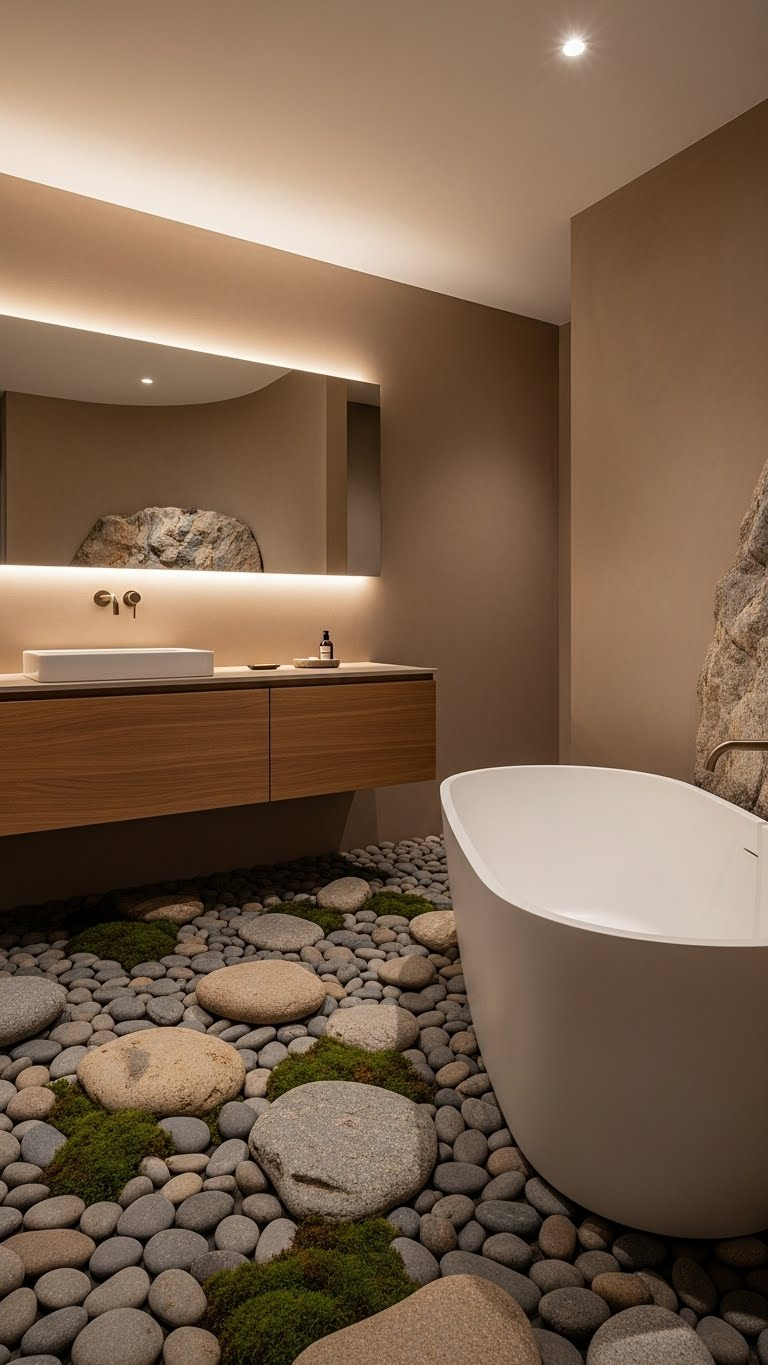
Instead of traditional repetitive tiling, using flat river stones for the shower floor or a small “landing” under the vanity provides a grounding, sensory experience.
The smooth, water-worn texture underfoot offers a gentle massage, reinforcing the room’s identity as a restorative space rooted in nature’s elements.
To keep the look minimalist, choose stones that are tonally consistent with your wall plaster or microcement to avoid a busy appearance.
This subtle shift in texture provides a high-end, bespoke feel that delights guests and maintains the sophisticated, organic “flow” of a modern earthy home.
16#. Anchoring with a Basalt Vessel Sink
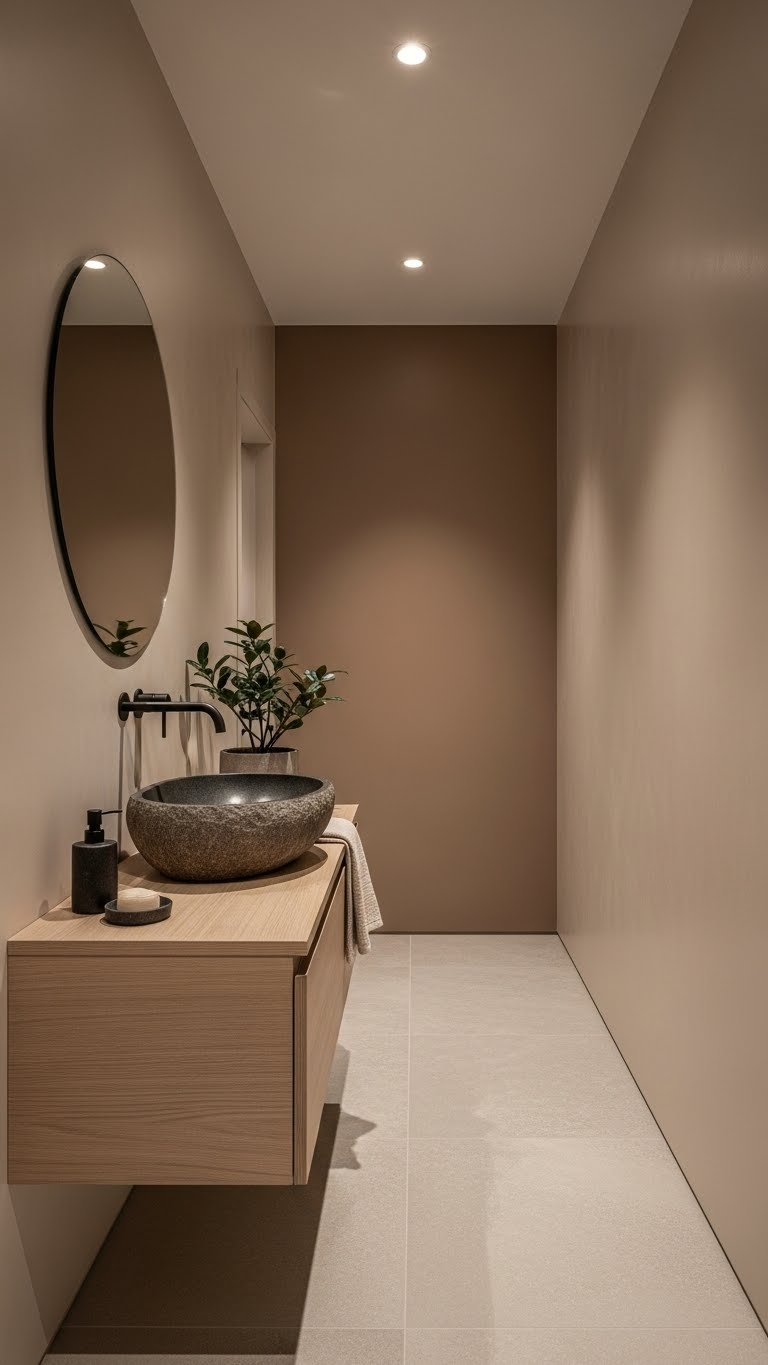
A dark, matte basalt sink provides a heavy, grounding element that contrasts beautifully against lighter hallway walls.
The volcanic stone’s natural density and charcoal hue offer a sophisticated alternative to standard white porcelain, anchoring the room’s minimalist design with a sense of permanence and strength.
To keep the look modern, pair this heavy vessel with a thin, wall-mounted faucet and a simple floating counter.
This setup maintains a clear “line of sight” beneath the sink, ensuring that the small bathroom footprint remains feeling open and uncluttered as people move through the corridor.
17#. Softening the Grid with Circular Mirrors
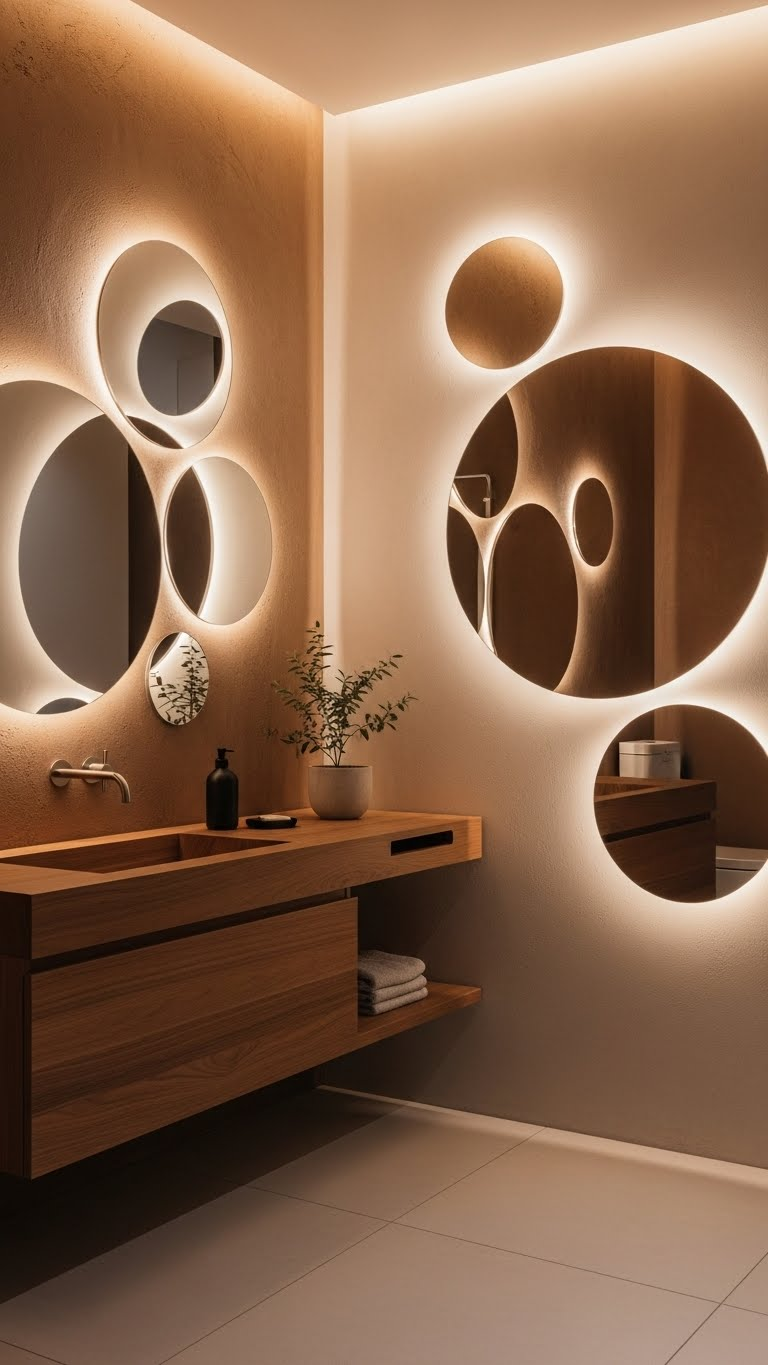
Introducing a large, frameless circular mirror breaks up the rigid, linear angles often found in hallway architecture.
The organic shape mimics the moon or a smooth river stone, providing a visual “rest” that aligns with the calming principles of minimalist, earth-centered design.
Backlighting the mirror with a soft LED glow enhances the “floating” effect, casting a gentle halo over the plaster or stone wall behind it.
This subtle lighting technique adds depth to the room without requiring bulky fixtures, keeping the small space feeling serene and expensive.
18#. Incorporating Terrazzo for Subtle Texture
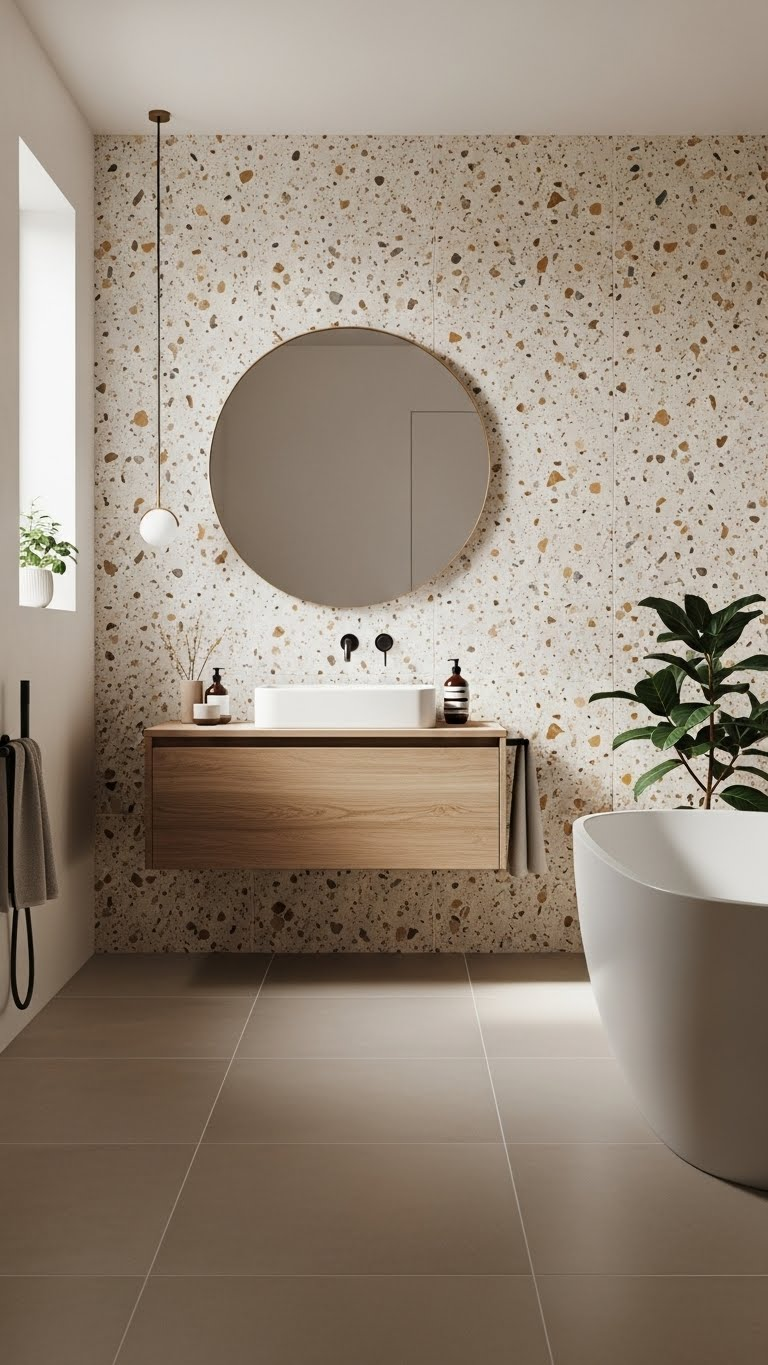
Terrazzo flooring with large, earthy aggregate provides a play of color that feels like a collection of riverbed minerals. By choosing a base of warm sand or clay, the flooring becomes a durable, textured foundation that ties together various wood and stone tones found in the adjacent hallway.
To keep it minimalist, ensure the terrazzo extends up the baseboard for a seamless, “wrap-around” effect that eliminates visual breaks.
This continuous surface makes the bathroom feel like a custom-sculpted grotto, offering a sophisticated and low-maintenance solution for high-traffic guest areas.
19#. Embracing the Warmth of Bronze Hardware
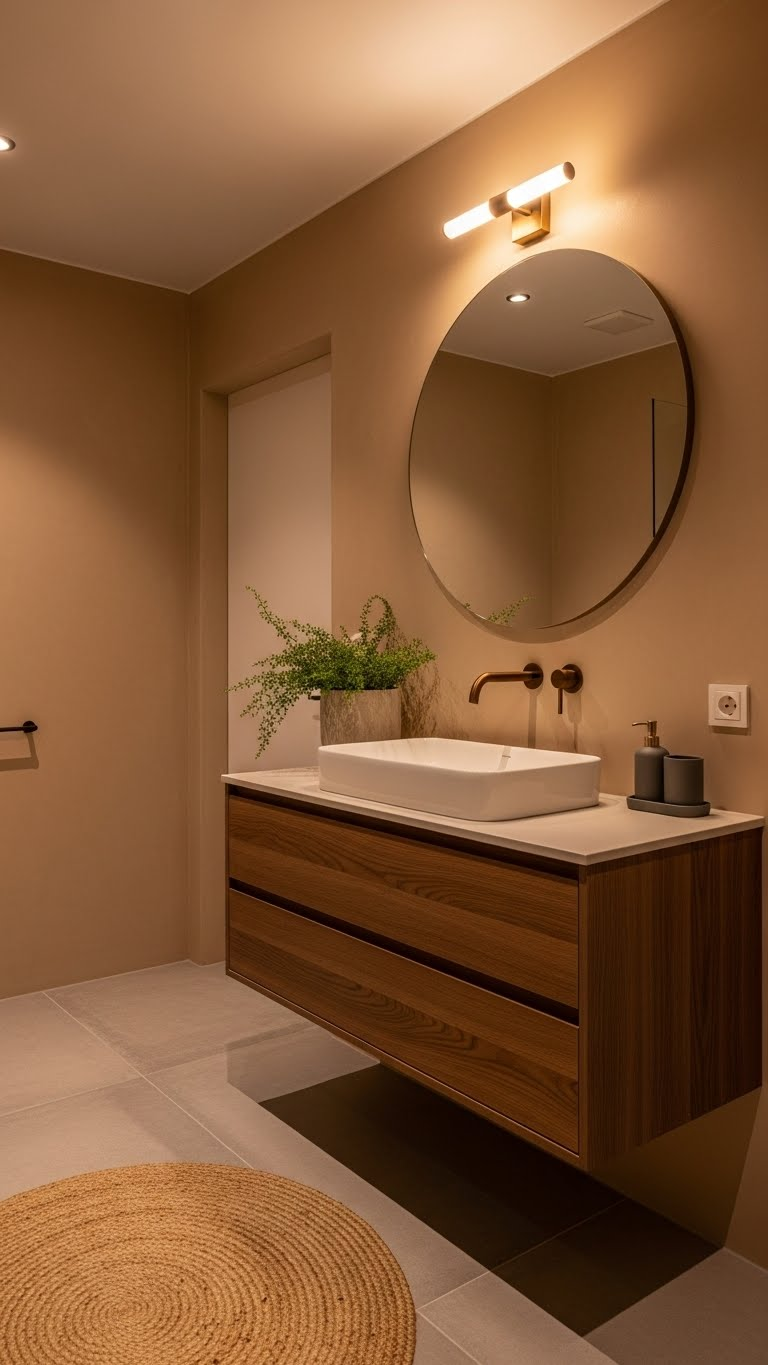
Moving away from cold chrome, brushed bronze or oil-rubbed bronze hardware adds a rich, metallic warmth to an Earthy Hallway Minimalist Bathroom.
These finishes possess a “living” quality that develops a unique character over time, harmonizing perfectly with natural oak or walnut vanities.
Minimalist lever handles and streamlined towel bars in bronze provide a quiet sense of luxury that feels substantial to the touch.
The dark, warm metal acts as a subtle anchor, drawing the eye toward functional elements without disrupting the overall tranquil, organic mood of the space.
20#. Designing with Travertine Wall Slabs
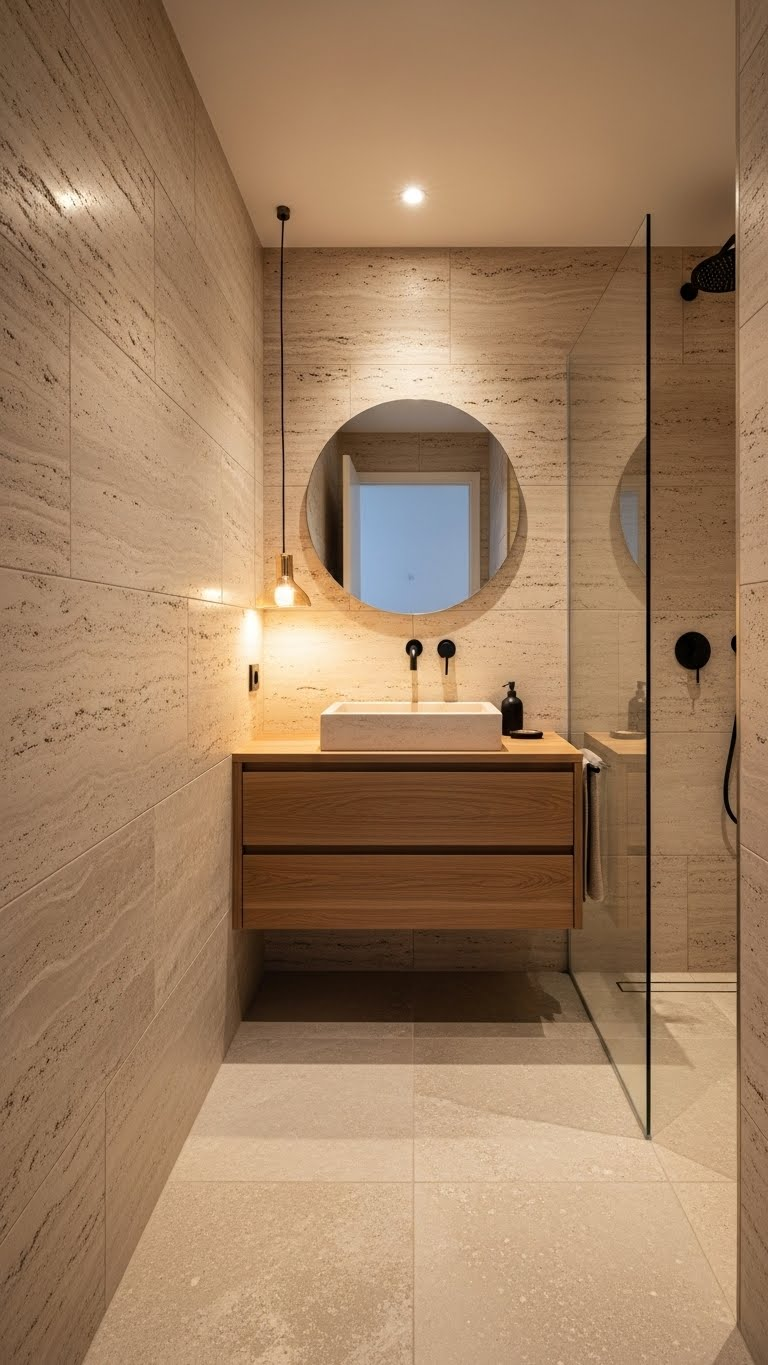
Large-format travertine slabs bring a timeless, architectural elegance to the walls of a minimalist bathroom.
The natural pits and porous texture of the stone provide a tactile quality that standard tiles lack, making even a tiny powder room feel like a high-end destination.
To maintain a minimalist flow, use the same stone for both the walls and the vanity countertop to create a monolithic look.
This reduction in material variety allows the natural veining of the travertine to become the primary design feature, celebrating the raw beauty of the earth’s crust.
21#. Rooting the Design with Petrified Wood Vanities
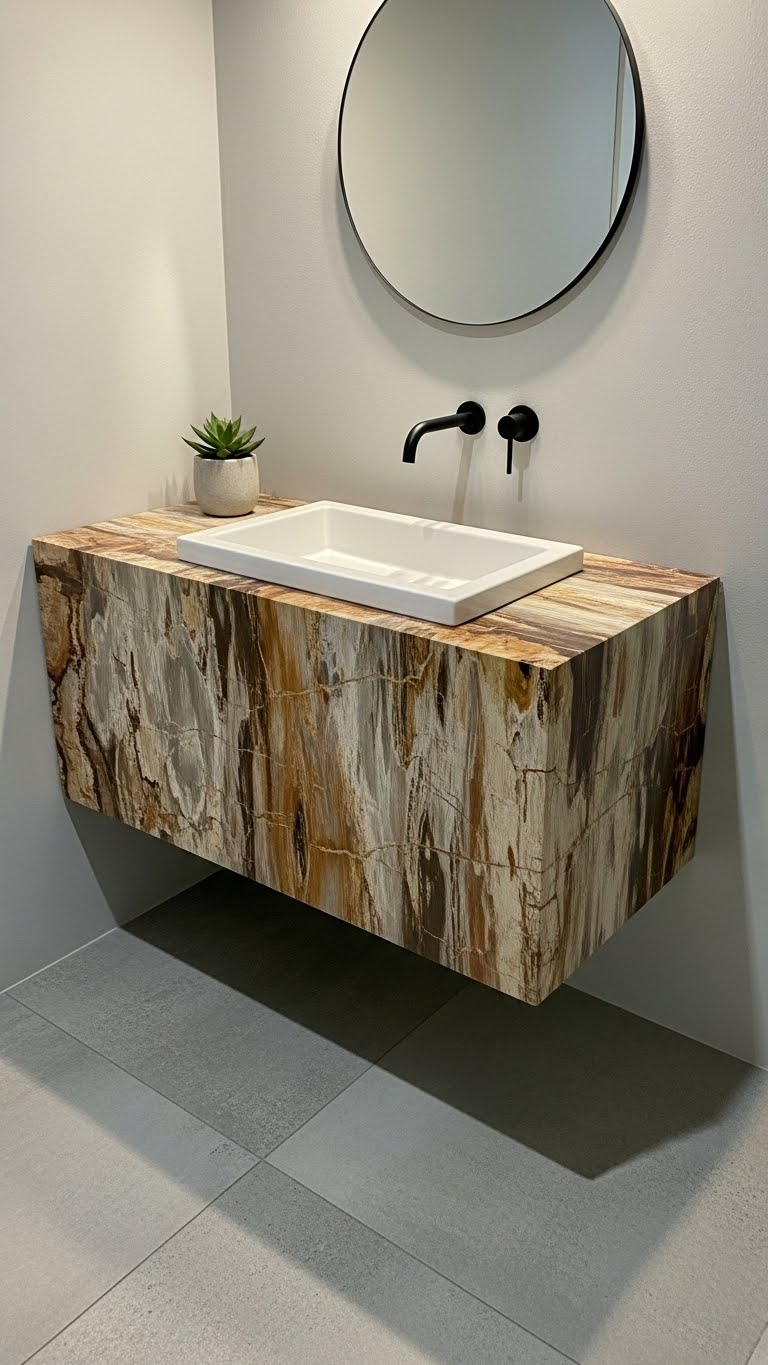
Introducing a vanity or side table made from petrified wood adds a fossilized, prehistoric energy to your Earthy Hallway Minimalist Bathroom.
These pieces are millions of years old and offer a unique, crystalline texture that bridges the gap between ancient stone and organic timber, making a bold statement in a small space.
Because petrified wood is essentially stone, it is incredibly durable and water-resistant, making it a perfect match for a high-end wet room.
This choice creates a conversation-starting focal point that highlights your commitment to the most authentic, raw materials the planet has to offer while keeping the footprint compact.
22#. Sculpting Light with Concrete Pendants
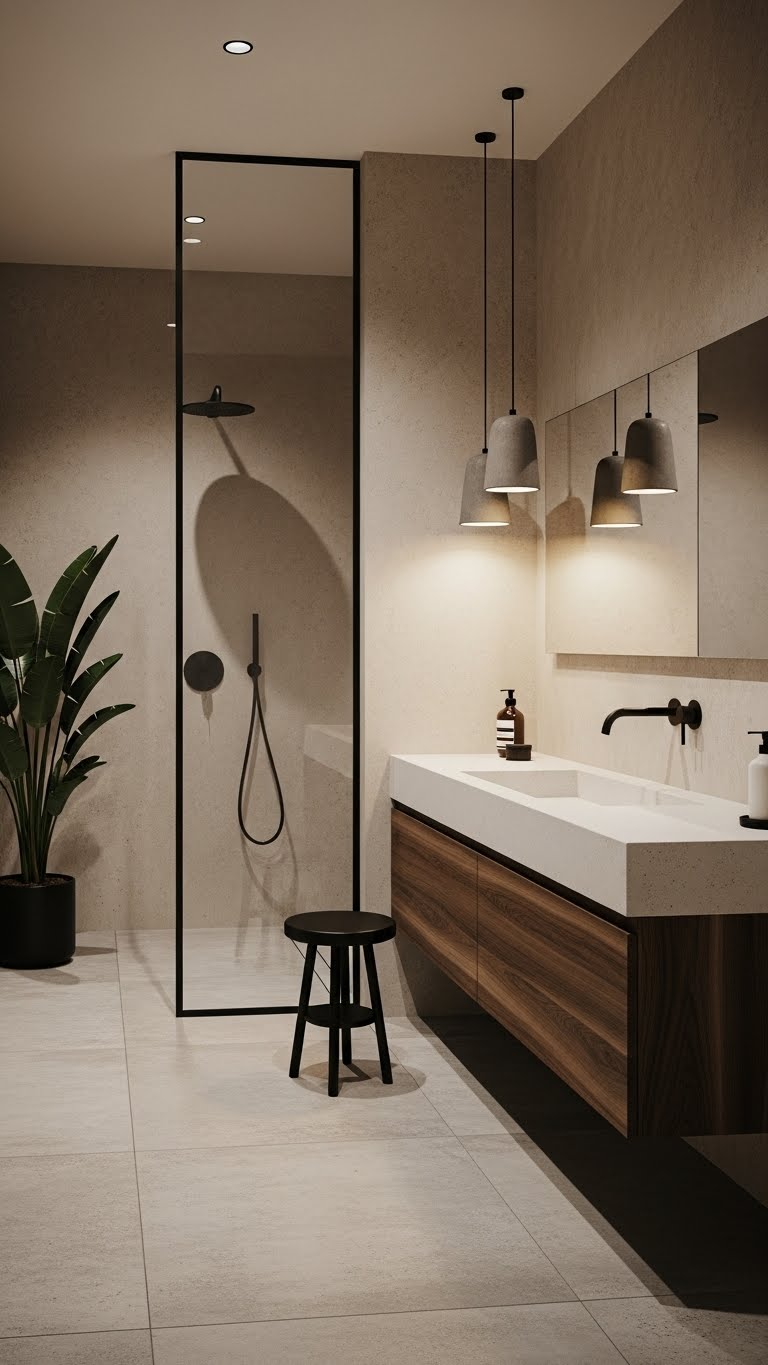
Hand-poured concrete light fixtures bring a modern, architectural weight to a minimalist bathroom while maintaining a neutral, mineral-based palette.
The matte, porous finish of the concrete contrasts beautifully against the shimmer of water and the glow of warm wooden cabinetry, grounding the room’s upper half.
Using these heavy-duty materials in an unexpected way—like hanging lights—adds a layer of contemporary urban grit to the softer, organic elements.
It provides a grounded, industrial-chic edge that ensures your nature-inspired sanctuary feels like a sophisticated, forward-thinking 2026 design.
23#. Connecting to Nature via Internal Glass Voids
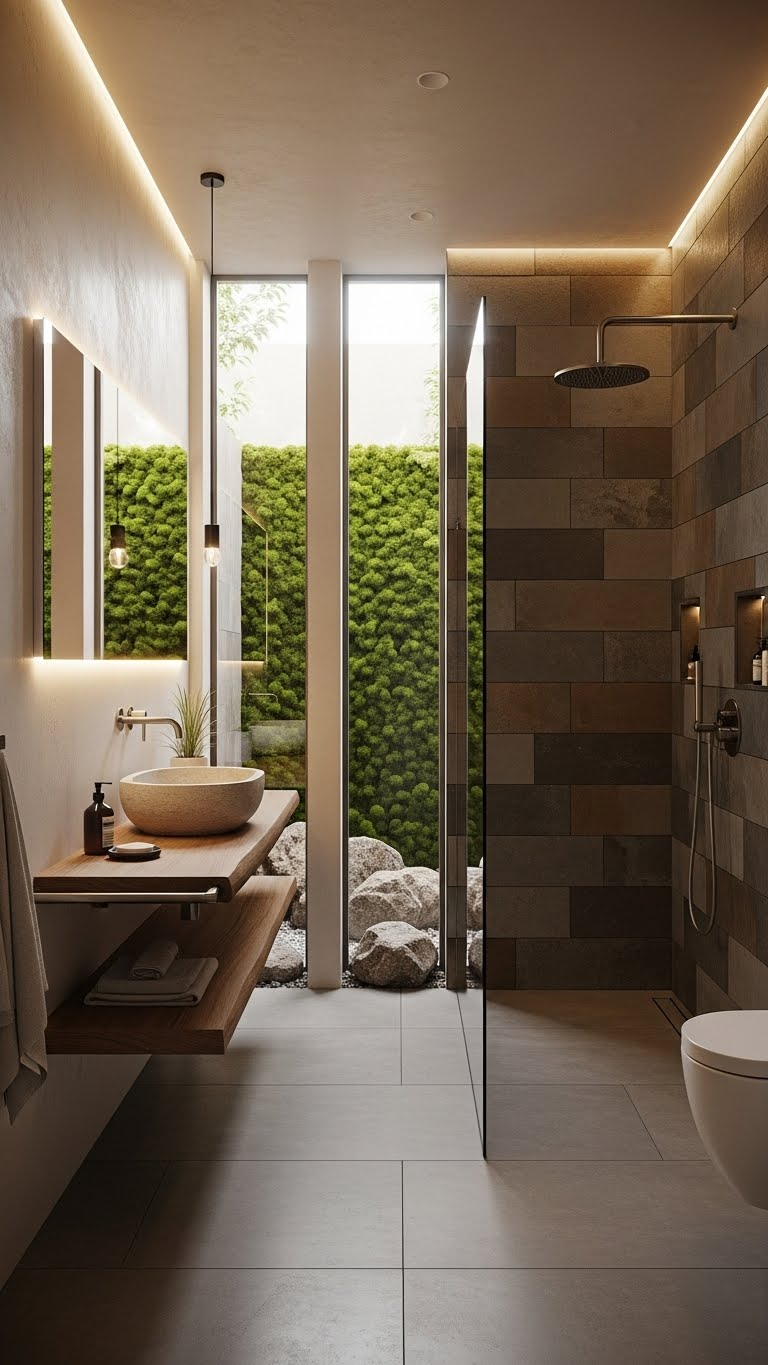
If your hallway layout allows, a small internal glass void or “light well” can bring a direct, private connection to nature into a windowless bathroom.
This architectural feature can house a single stone sculpture or a tall fern, visible through a floor-to-ceiling glass pane, creating a living mural.
The presence of a small, contained garden within the room reinforces the concept of a “biophilic” retreat where the indoors and outdoors coexist seamlessly.
It brings a sense of wonder and fresh air into your daily routine, elevating the bathroom into a high-design architectural masterpiece that feels larger than its square footage.
24#. Weaving Warmth with Integrated Rattan Panels
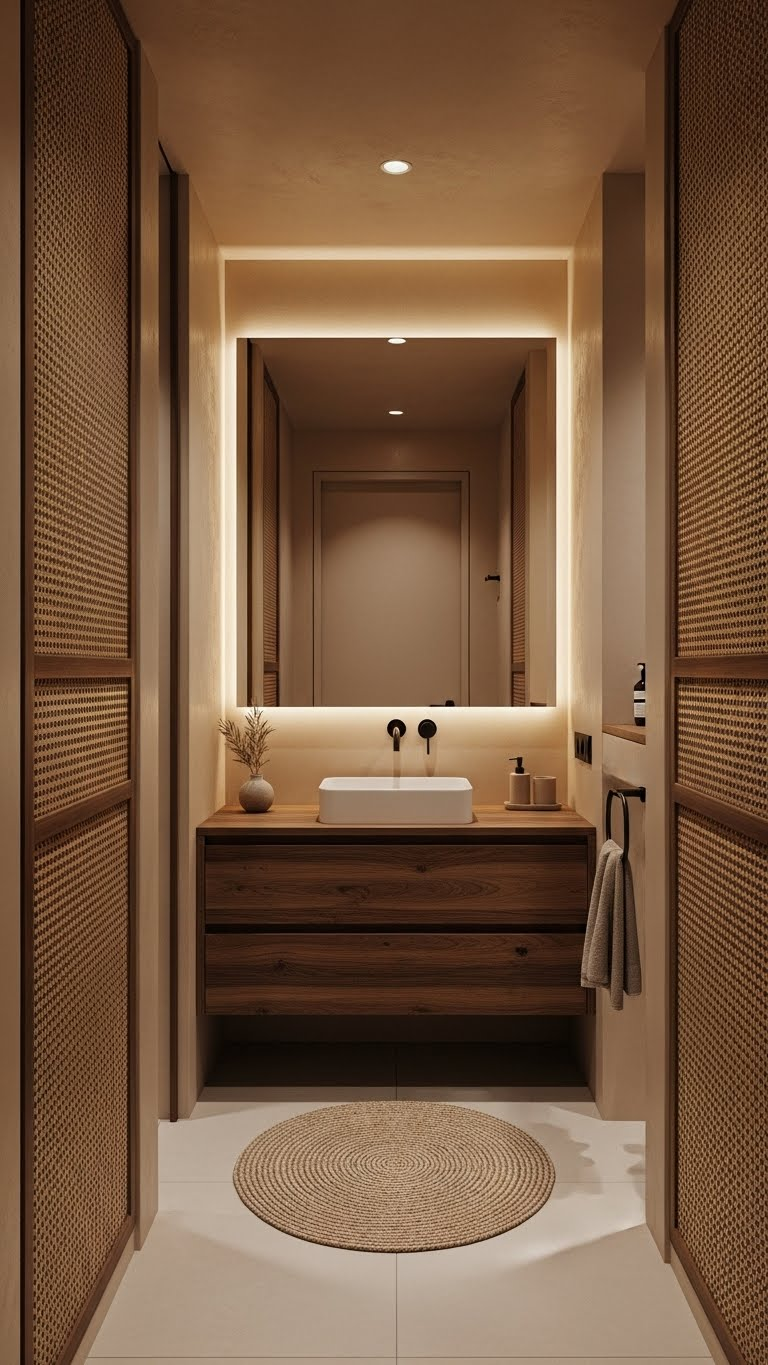
Incorporating rattan or woven cane inserts into vanity doors provides a lightweight, breathable texture that balances the heavy stone surfaces.
These natural fibers bring a sense of handcrafted warmth and a relaxed, bohemian spirit to the otherwise structured and minimalist hallway bathroom.
The golden-brown tones of the weave harmonize perfectly with unlacquered brass and oak, creating a rich, tonal palette that feels deeply layered.
These materials are also practical for high-moisture environments, as they allow for air circulation in the humid environment of a private spa.
25#. Anchoring the Space with Honed Basalt Floor Tiles
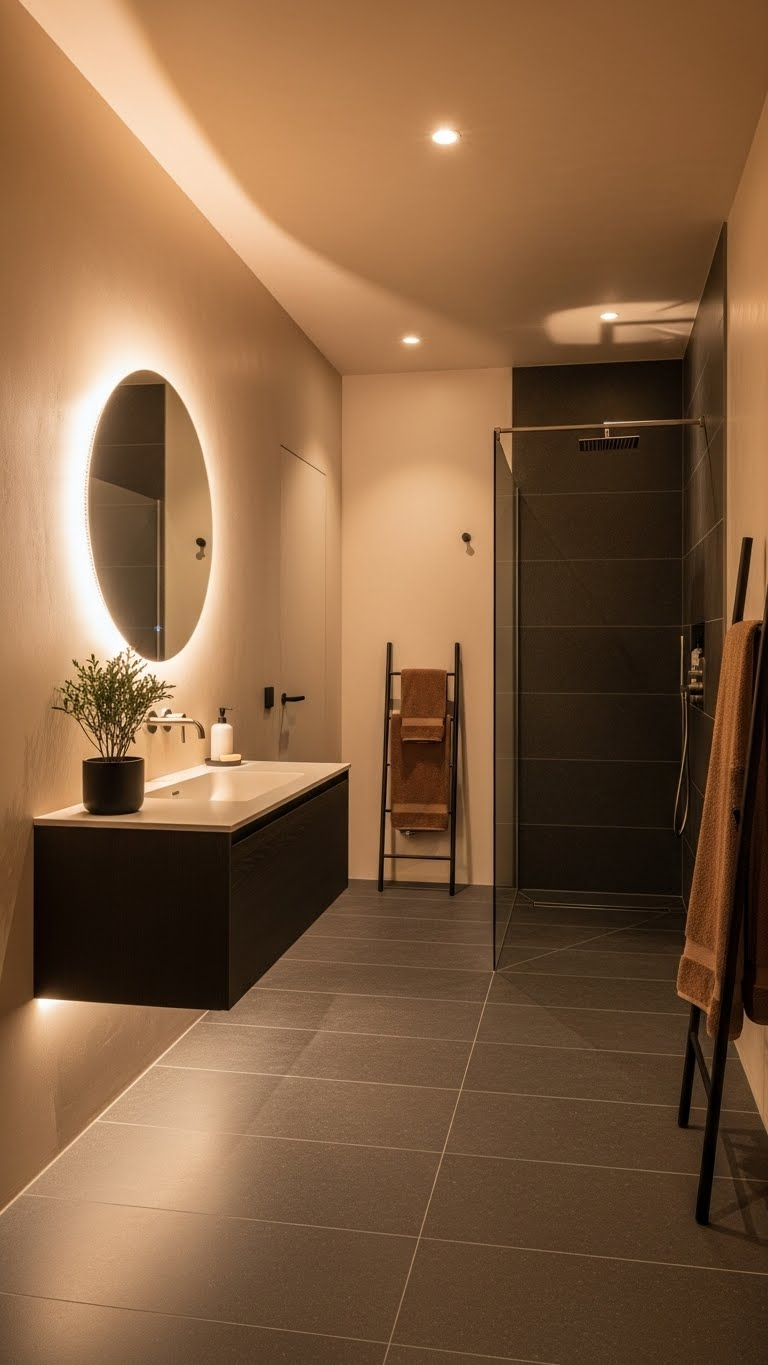
Basalt is a volcanic rock that offers a consistent, dark grey tone and an incredibly dense structure perfect for a high-traffic hallway bathroom.
Using basalt tiles for the floor provides a sleek, modern foundation that feels incredibly sturdy and permanent underfoot, acting as a visual anchor.
The cool, charcoal hue of the volcanic stone acts as a neutral base that allows your greenery and wooden accents to pop with vibrant life.
Its subtle, matte texture is sophisticated and understated, embodying the “quiet luxury” that defines the most successful modern organic interiors today.
26#. Softening Angles with Fluted Wood Walls
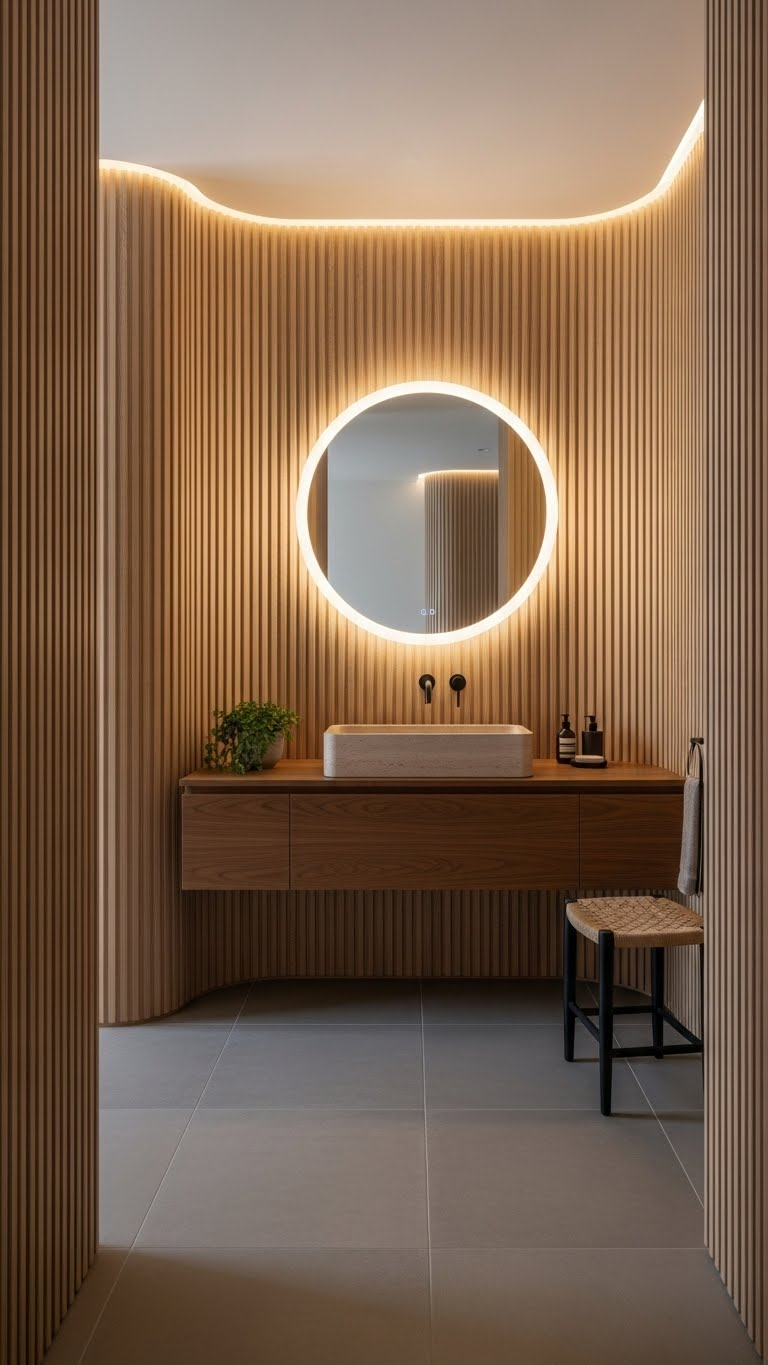
Adding a fluted or tambour wood wall treatment brings a rhythmic, vertical texture that softens the hard corners of a minimalist bathroom.
This design element adds architectural depth without requiring extra space, making it an ideal choice for narrow bathrooms located off a main hallway.
The vertical lines of the fluting create a play of light and shadow that changes throughout the day, adding a dynamic quality to the room.
When paired with a simple stone sink, the wood provides a warm, tactile backdrop that feels contemporary, artisanal, and deeply connected to nature.
27#. Embracing Simplicity with Limestone Vessel Sinks
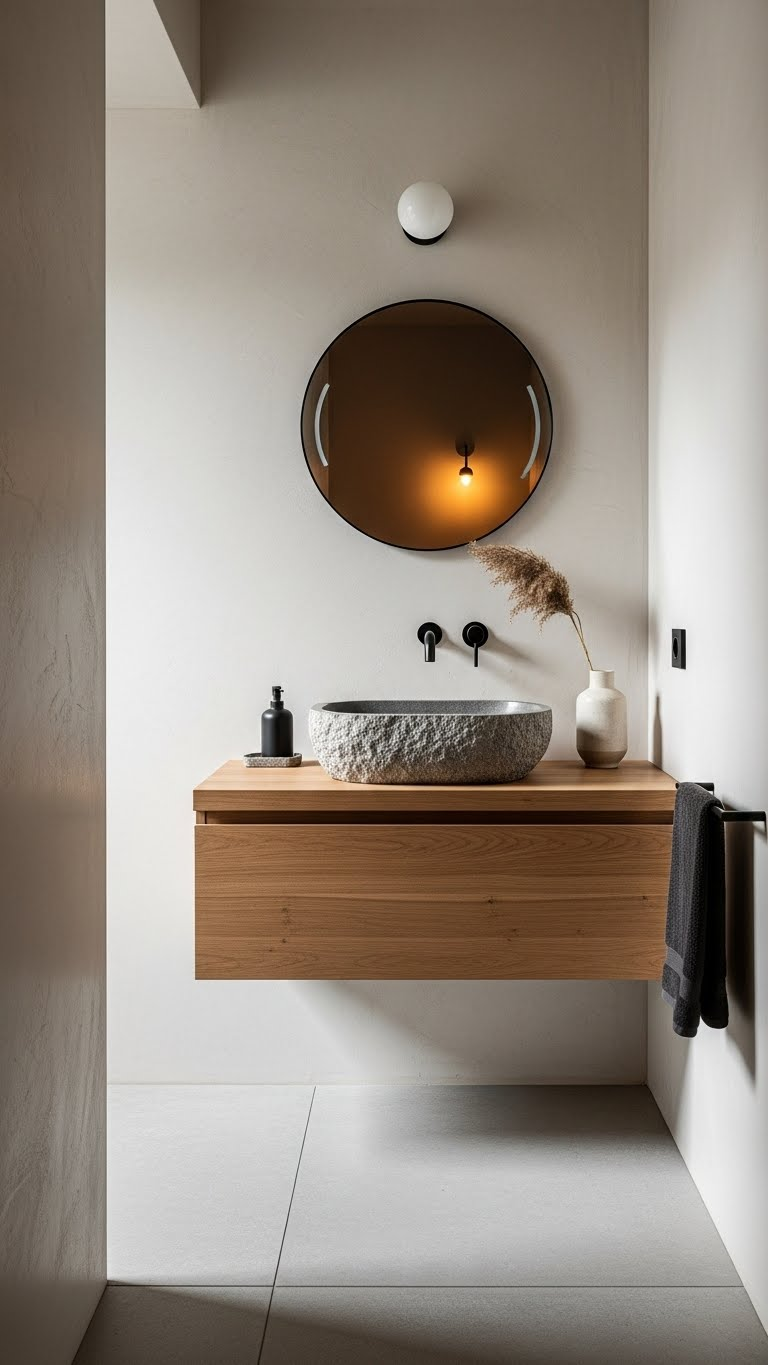
A vessel sink carved from creamy limestone offers a softer, more ethereal alternative to darker stones like basalt or granite.
The light, sandy tones of the limestone blend effortlessly with neutral hallway colors, creating a bright and inviting atmosphere in a smaller guest bathroom.
The natural fossil markings and subtle veining in the limestone ensure that each sink is a unique work of art.
By keeping the faucet design minimal and the countertop clear, you allow the raw, unrefined beauty of the limestone to serve as the room’s primary decorative element.
28#. Defining Space with Smoke Glass Partitions
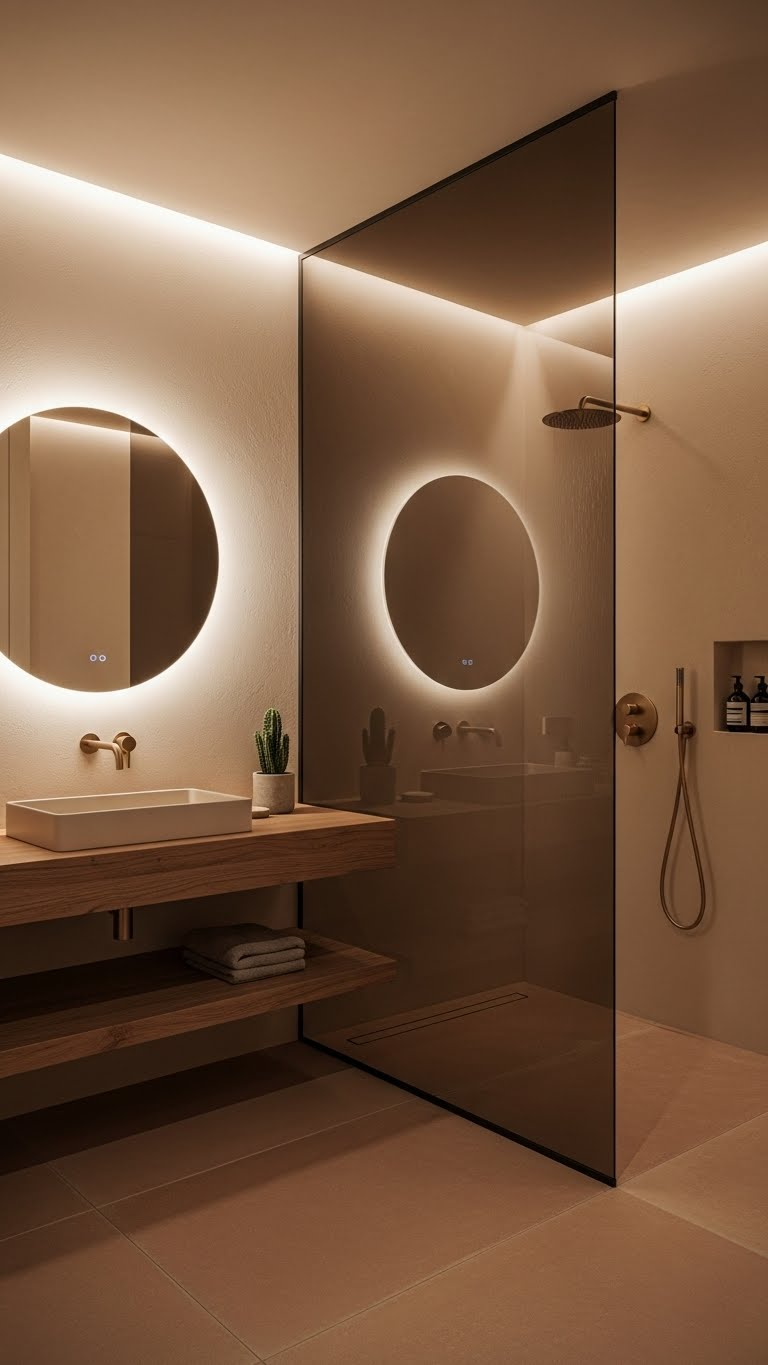
Replacing traditional shower curtains with a smoke-tinted glass partition adds a layer of moody, minimalist sophistication to the bathroom.
The darkened glass provides a sense of privacy while still allowing light to flow through, maintaining the open and airy feel required for small spaces.
The “smoke” hue complements earthy tones like charcoal slate or deep forest green, adding a contemporary edge to the organic materials.
It acts as a sleek, architectural divider that keeps the bathroom looking tidy and expensive, seamlessly integrating with the modern aesthetic of the rest of the home.
29#. Finishing with Scented Mineral Diffusers
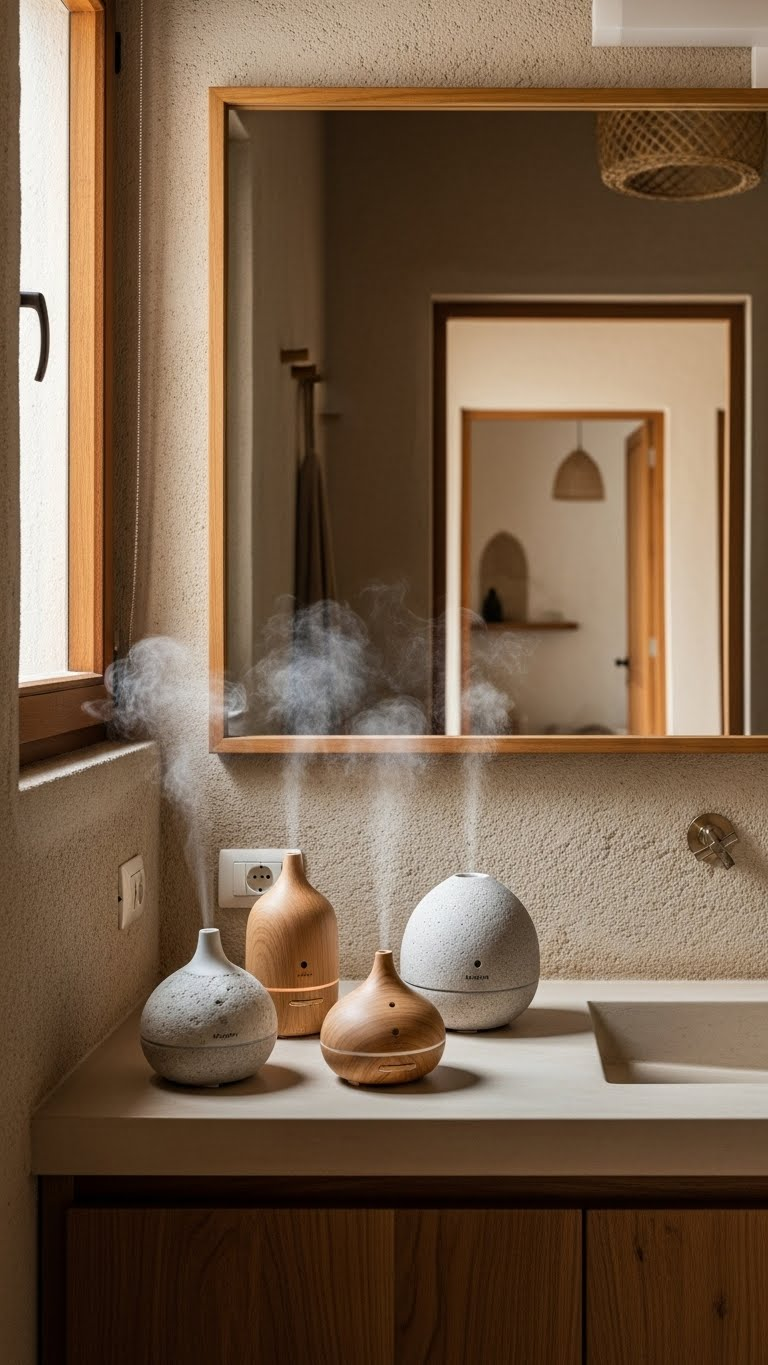
The final touch for an Earthy Hallway Minimalist Bathroom is a sensory one: a sculptural stone or lava rock diffuser.
Using natural essential oils like cedarwood or sandalwood grounds the space with a forest-like aroma, greeting anyone who enters from the hallway with an immediate sense of calm.
These mineral-based diffusers serve as functional decor, reinforcing the room’s commitment to natural materials even in the smallest details.
By engaging the sense of smell, you complete the transformation of a simple hallway bathroom into a multi-sensory, organic sanctuary that feels like a true retreat.
Final Thoughts
This complete list of 29 ideas demonstrates that Earthy Hallway Minimalist Bathrooms are at their best when they balance raw, “honest” materials with sleek, functional design.
By focusing on light, texture, and a restrained color palette, you turn a transition zone into a high-end architectural highlight.