Architecture provides the structural framework of a home—the bones, the volume, the flow of light, and the boundaries of space. Interior design, however, is the soul. When these two disciplines align seamlessly, a residence transforms from a mere shelter into a cohesive work of art.
Among the countless design movements available to the contemporary homeowner, few possess the inherent power to honor and elevate structural architecture quite like Modern Art Deco.
Originating in Paris during the 1910s and reaching its peak worldwide in the 1920s and 30s, classic Art Deco (Arts Décoratifs) was a celebration of post-war technological progress, industrial luxury, and unapologetic glamour. It was characterized by lavish materials, jagged zigzags, sunburst motifs, and exotic woods.
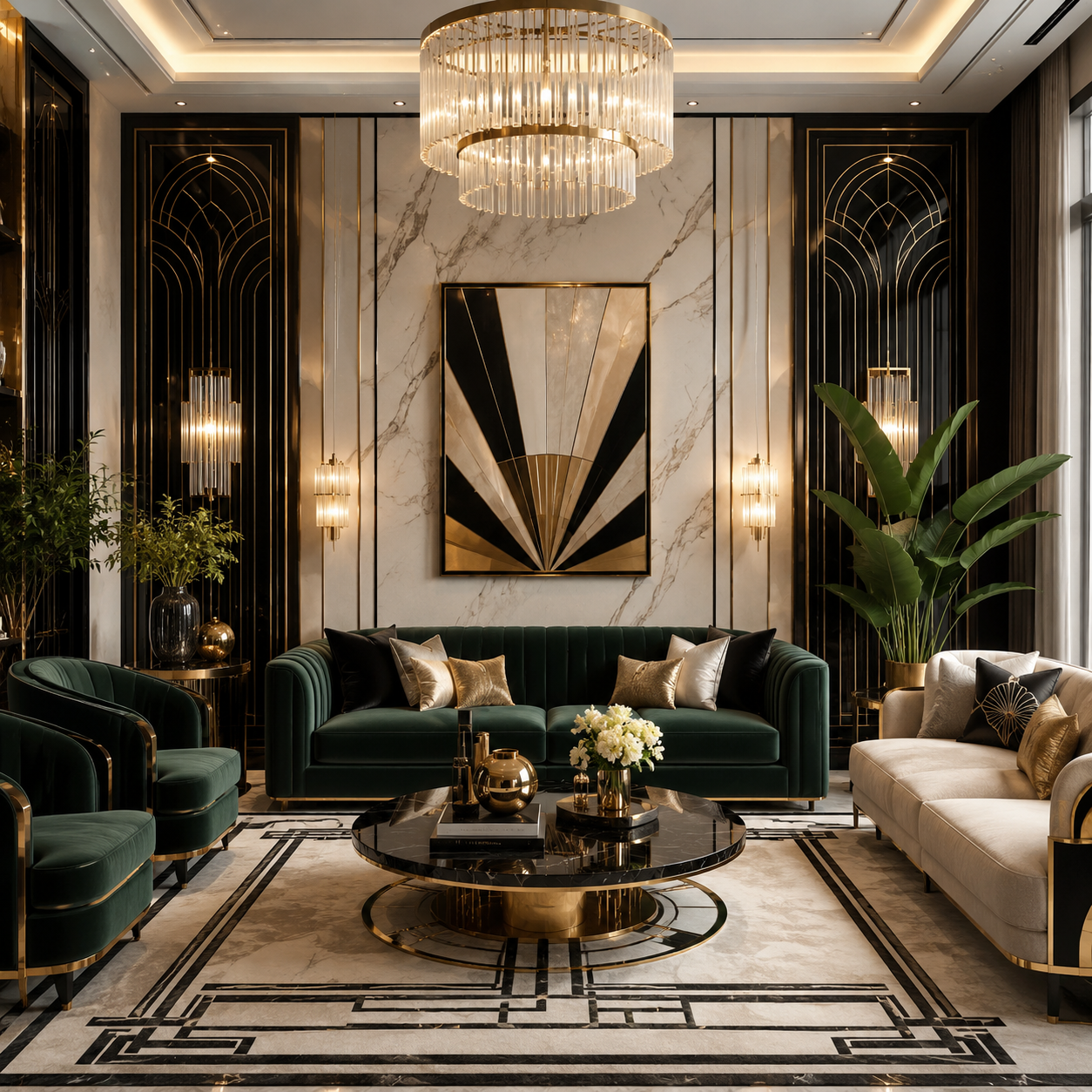
Fast forward to the present day: the movement has undergone a profound evolution. Modern Art Deco retains the opulence, structural discipline, and structural drama of its predecessor but filters it through a contemporary lens of minimalism, functionality, and organic balance.
This comprehensive guide explores how to design a Modern Art Deco living room that acts as a natural extension of your home’s architectural integrity. Whether you are working within a soaring urban loft, a mid-century suburban layout, or a crisp, new minimalist build, you will discover how to synthesize historic grandeur with forward-thinking interior design.
1. The Anatomy of Modern Art Decor
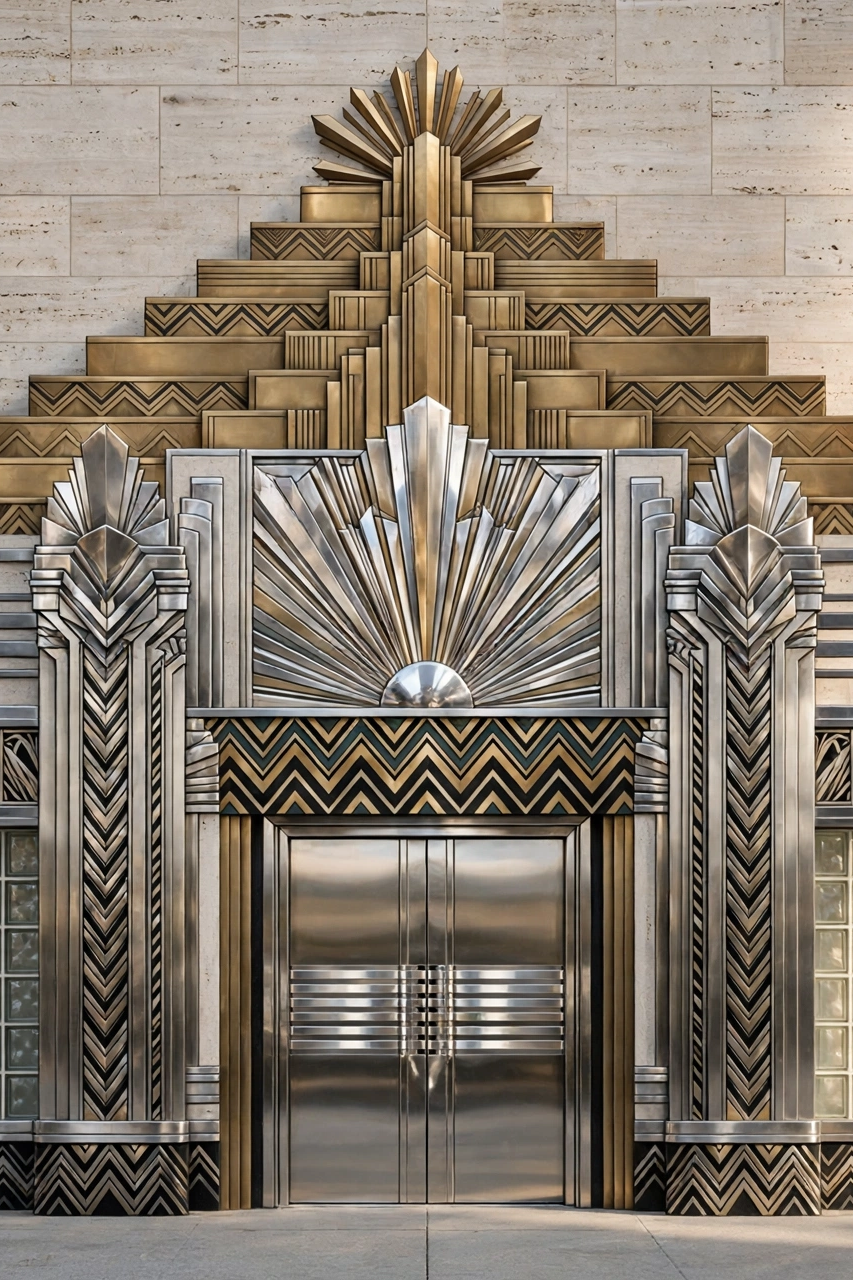
To successfully implement Modern Art Deco, one must understand how it differs from its historical ancestor. Classic Art Deco could occasionally border on the visually exhausting; it favored highly polished surfaces everywhere, busy wallpapers, and an abundance of decorative trinkets.
Modern Art Deco, by contrast, relies on restraint. It treats luxury not as an accumulation of things, but as a curated collection of high-impact choices.
The modern iteration champions the marriage of form and function. It takes the signature geometric rigor of the 1920s—the sweeping curves, the stepped silhouettes, the sunburst patterns—and applies them to spaces that breathe. The result is a living room that feels cinematic yet completely livable, glamorous yet deeply anchored in the architectural realities of the 21st century.
2. Assessing Your Structural Canvas

Before purchasing a single piece of furniture, you must evaluate the architectural canvas of your living room. Modern Art Deco does not ignore the existing space; it flatters it.
High Ceilings and Vertical Volumes
If your living room boasts expansive vertical space, you possess the ideal playground for Art Deco’s love of height and drama. Structural elements like exposed beams, double-height windows, or heavy crown molding can be emphasized using vertical linework. Vertical channeling on accent walls, floor-to-ceiling drapery, and towering stepped bookcases will draw the eye upward, celebrating the sheer volume of the architecture.
Compact or Low-Ceilinged Spaces
Do not assume that Art Deco requires a grand ballroom to succeed. In intimate living rooms, the modern approach acts as an exceptional tool for spatial optimization. By utilizing low-slung furniture with strong horizontal lines, elongated mirrors, and highly reflective accents (like polished chrome or brass), you can visually expand the square footage. The inherent geometry of the style provides a sense of order and structure that prevents a small room from feeling cluttered.
Window Formats and Natural Light
Art Deco thrives on the interplay of light and shadow. If your home features traditional multi-pane windows, arched window frames, or minimalist floor-to-ceiling glass, your interior layouts should complement these openings. Position seating arrangements to capitalize on the incoming light, allowing it to catch the metallic inlaid details of your tables or the rich pile of your textiles throughout the day.
3. Walls, Floors, and Ceilings
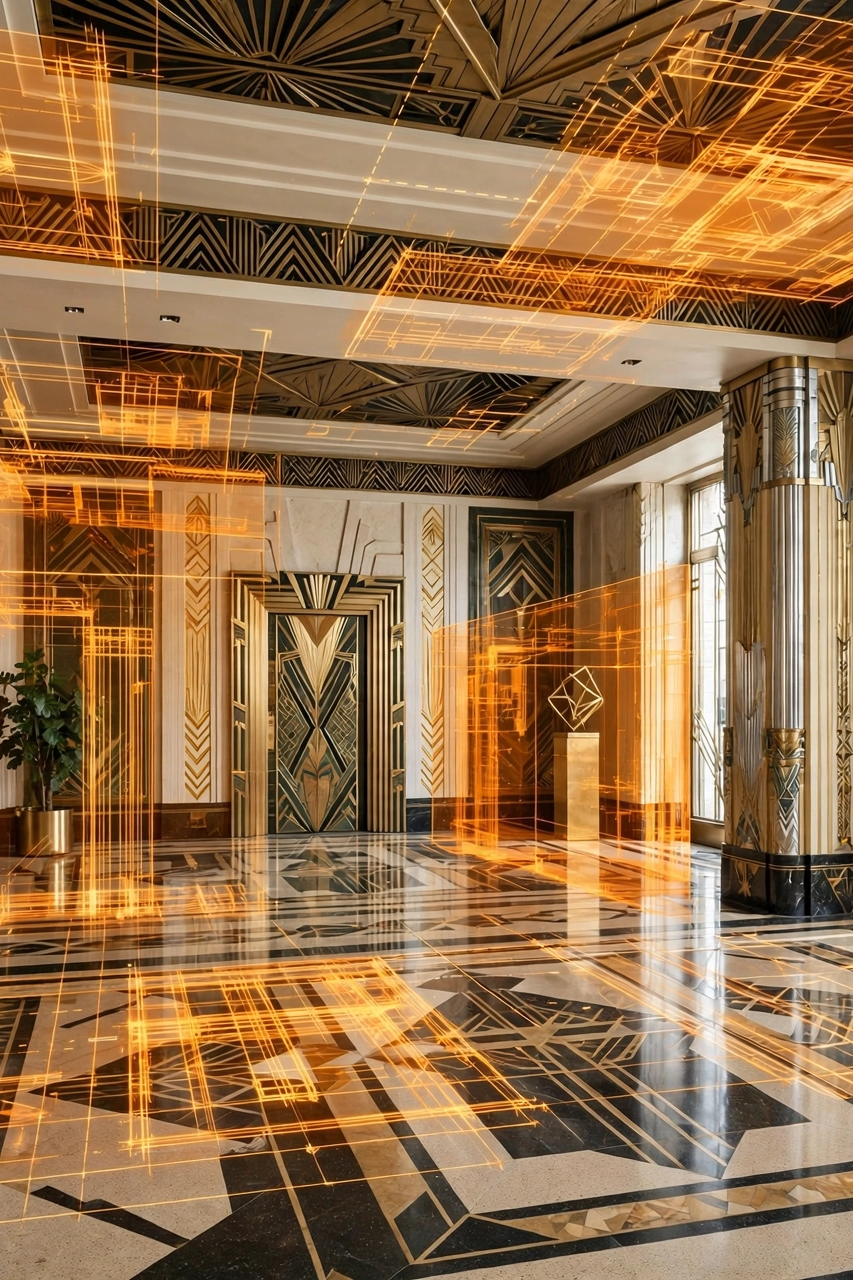
The surfaces of your living room set the stage for the furniture and decor. In a Modern Art Deco space, these foundations should feel inherently architectural.
Wall Treatments: Geometry and Texture
Plain drywall rarely does justice to an Art Deco concept. Consider introducing architectural dimension through modern wall applications:
- Applied Molding and Millwork: Create large-scale geometric frames or panels on your walls using simple wood trim. Instead of intricate Victorian filigree, keep the lines clean, straight, and sharp.
- Fluted and Channelled Panels: Vertical fluting—whether applied as a floor-to-ceiling accent wall behind the television or as low wainscoting—adds immediate texture and architectural rhythm.
- Wallpaper with Restraint: If you choose an Art Deco wallpaper (such as a stylized fan or shell motif), relegate it to a single accent wall, an inset panel, or even the ceiling. Opt for colorways that feature metallic inks over matte backgrounds to catch ambient light.
Flooring: The Anchor of the Room
The floor is the physical anchor of your living room’s architecture. To achieve an authentic yet updated Art Deco foundation, look to these materials:
- Chevron and Herringbone Hardwood: Traditional parquet flooring is a hallmark of early 20th-century Parisian apartments. Utilizing wide-plank oak or walnut laid in a chevron pattern provides a dynamic, directional movement across the floor.
- Large-Format Stone Tile: For modern builds, large-format porcelain or marble tiles with distinct, dramatic veining create a sleek, cool, and highly luxurious surface.
- Monolithic Polished Concrete: In industrial or ultra-modern homes, polished concrete serves as a brilliant neutral counterpoint to the velvet and brass elements of the Art Deco furniture, highlighting the tension between raw structure and refined luxury.
The “Fifth Wall”: Elevating the Ceiling
Art Deco design rarely leaves the ceiling as an afterthought. If your architecture permits, consider adding a stepped tray ceiling, which mimics the ziggurat structures popular in 1920s skyscrapers. Alternatively, painting the ceiling a deep, dark hue—or applying a subtle metallic finish—can create an intimate, sophisticated atmosphere, especially in rooms dedicated to evening relaxation.
4. Balancing Neutrals with Drama
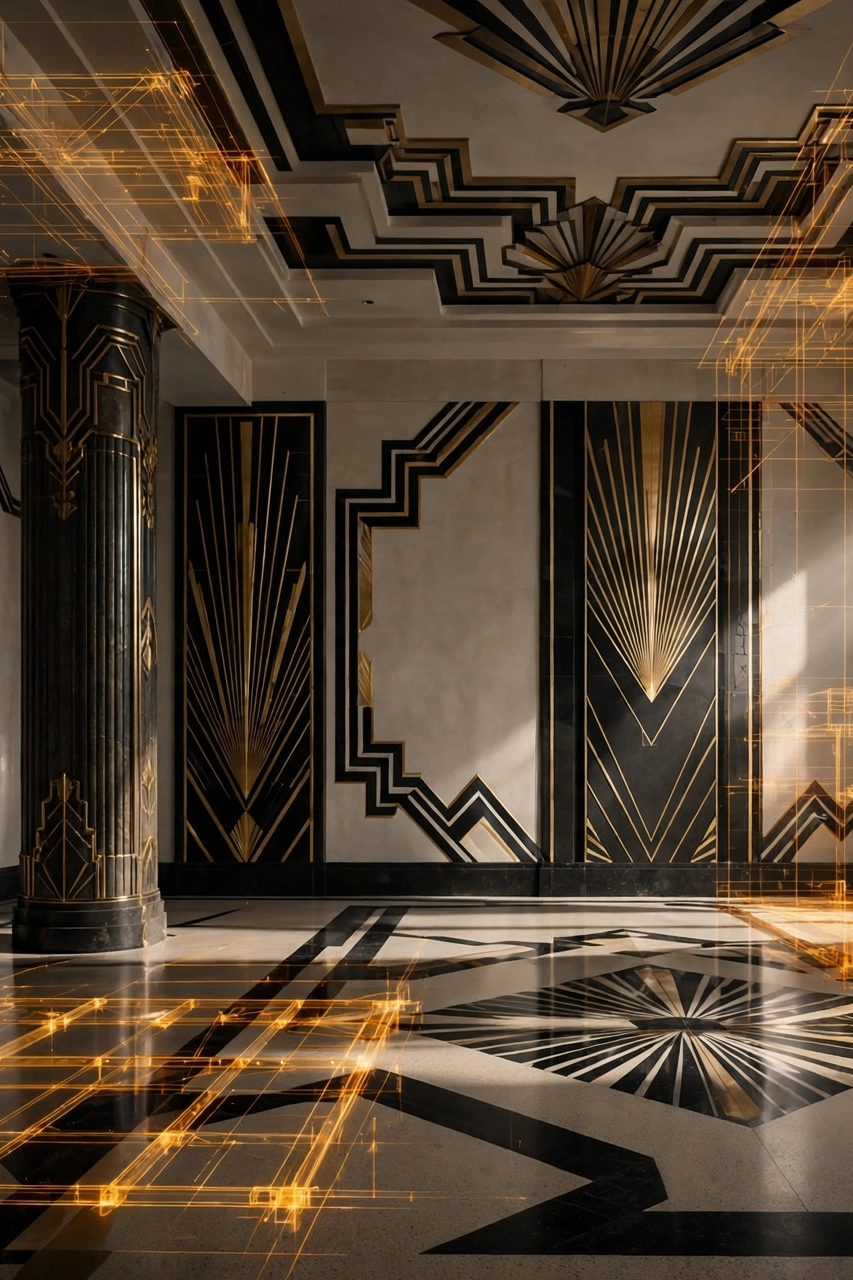
Color in a Modern Art Deco living room serves two purposes: it defines the boundaries of the architecture and it injects emotional drama. The modern palette abandons the chaotic color schemes of the past in favor of a highly structured, intentional framework.
The 70-20-10 Rule
To maintain visual balance, allocate your colors intentionally throughout the living room space:
- 70% Foundation Neutrals: Your walls, large architectural built-ins, and largest upholstered pieces should adopt sophisticated neutrals. Think chalky alabasters, deep charcoal, muted taupe, or soft greige. This ensures the room feels grounded, airy, and contemporary.
- 20% Architectural Accents: Introduce deep, saturated tones to define specific zones or elements. Excellent choices include rich emerald green, midnight sapphire, plum, or a dusty, burnt terracotta. Use these for accent chairs, drapery, or secondary wall treatments.
- 10% Metallic Highlights: The literal shine of the room. Reserve this for lighting frames, furniture inlays, hardware, and decorative objects. Polished brass, brushed gold, and satin chrome add that undeniable touch of vintage opulence without overwhelming the senses.
5. Form, Silhouette, and Mass
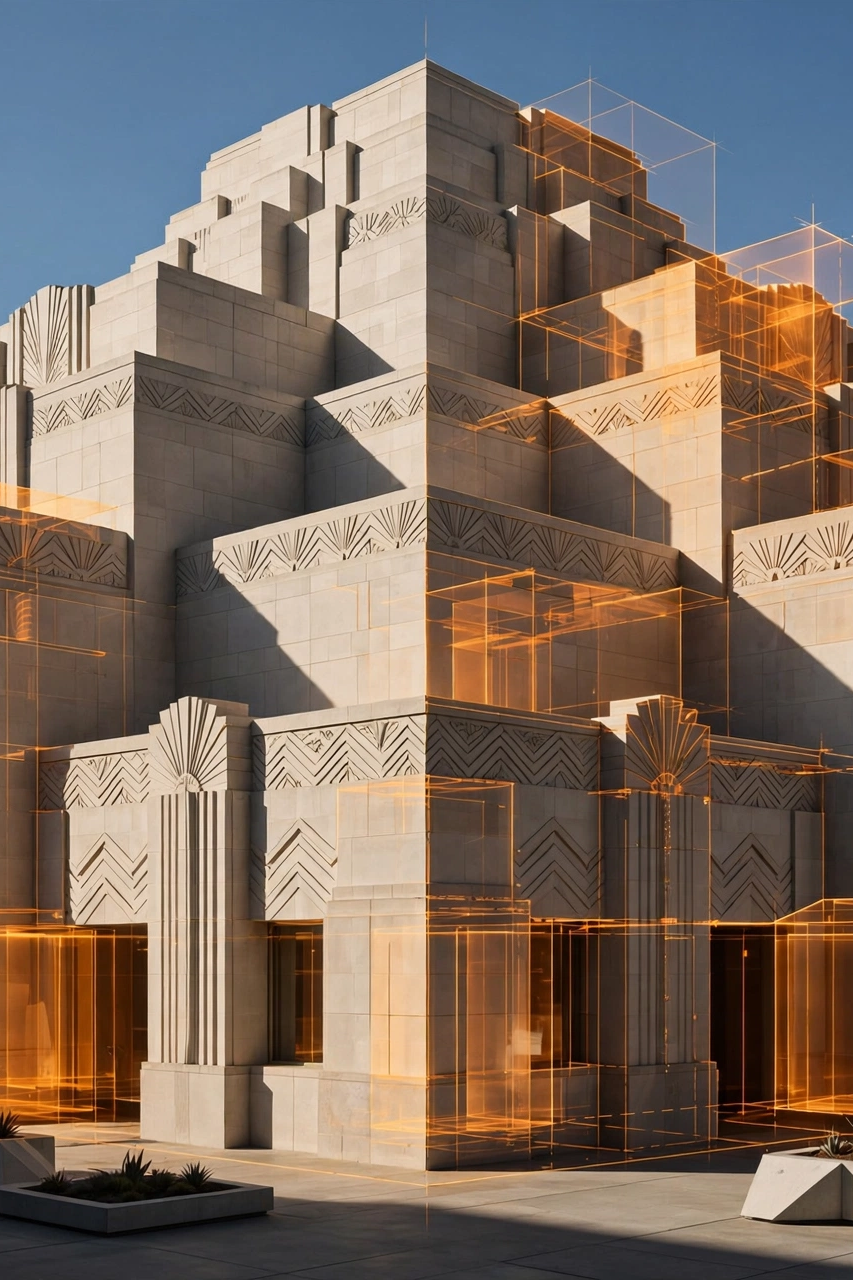
Furniture in a Modern Art Deco living room should be viewed as functional sculpture. Each piece needs to possess a distinct silhouette and a palpable sense of weight, interacting purposefully with the surrounding architecture.
Seating: The Power of the Curve
The centerpiece of any living room is its seating arrangement. While modern minimalism favors hard, right-angled boxes, Art Deco introduces the grace of the curve:
- The Curved Sofa: A gently sweeping, crescent-shaped or asymmetrical sofa instantly breaks up the rigid, linear nature of standard rectangular rooms. It encourages conversation and softens the architectural perimeter.
- Vertical Channel Tufting: Opt for sofas and armchairs that feature clean vertical channeling. This stitching method creates structural columns within the upholstery, echoing classical architectural pillars.
- Exposed Frames: Look for lounge chairs that feature bold, exposed structural frames crafted from tubular brass or dark, high-gloss lacquered wood. The frame itself becomes a graphic element within the space.
Tables: Geometric Continuity
Coffee tables, side tables, and consoles offer the perfect opportunity to reintroduce strong geometric forms into the heart of the layout:
- Material Contrasts: A coffee table that pairs a thick, heavily veined Calacatta marble top with a brushed gold geometric base embodies the spirit of the movement.
- Stepped and Layered Forms: Nesting tables or tiered coffee tables mimic the iconic ziggurat architecture of the early 20th century, providing visual depth and functional versatility.
- Monolithic Pedestals: Plinth-style tables made from solid travertine, dark stained oak, or colored glass add a sense of permanent, architectural mass to the center of your seating zone.
6. Lighting as Architectural Sculpture
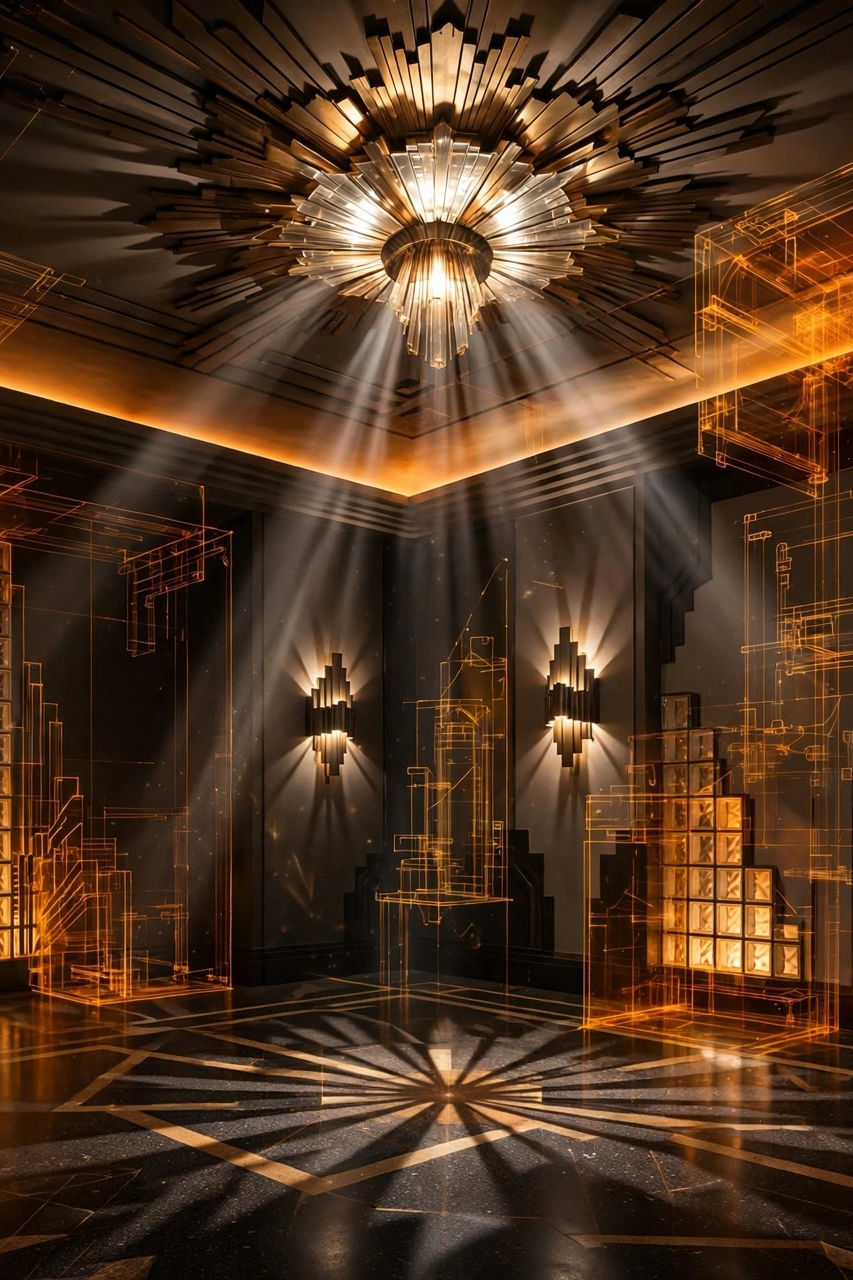
Lighting is arguably the most critical component of the Modern Art Deco aesthetic. In this style, fixtures do not merely illuminate a room; they command it. They act as jewelry for the architecture.
The Showstopping Chandelier
Every Modern Art Deco living room requires a definitive overhead focal point. Look for chandeliers that emphasize geometric repetition:
- Tiered Glass Rods: Fixtures featuring concentric rings of clear or smoked glass tubes create a breathtaking, diffused glow while maintaining a heavy, structural presence.
- Sputnik and Sunburst Motifs: Linear brass arms radiating outward from a central point provide a dynamic energy that works beautifully in double-height spaces or rooms with clean, minimalist ceilings.
- Architectural Mobiles: Modern fixtures that utilize balanced geometric shapes—spheres, cones, and rods—evoke the mid-century evolution of Art Deco, serving as hanging art pieces during the day and dramatic light sources at night.
Wall Sconces: Creating Structural Rhythm
Wall sconces are highly underutilized in contemporary interiors, yet they are essential to the Art Deco look. Flanking a fireplace, a large mirror, or an arched doorway with matching geometric sconces reinforces the symmetry of the room. Choose fixtures that direct light both upward and downward (up-down lighting) to highlight wall textures, fluting, or paint finishes, adding dramatic depth to the room’s perimeter.
Task and Ambient Lamps
Floor and table lamps should continue the material narrative of the room. Look for lamps with solid marble bases, conical or spherical glass shades, and integrated brass switches. A tall arching floor lamp with a heavy dome shade can be positioned to curve elegantly over a reading chair, creating an intimate sub-zone within the larger architectural floor plan.
7. The Curation of Material Luxury

Once the structural foundations, color palettes, furniture, and lighting are established, the final layer of design involves textiles and accessories. This is where many decorators falter by overdecorating. The modern approach requires strict curation.
Textiles: Tactile Contrast
Because Modern Art Deco relies on a clean, often neutral backdrop, the tactile quality of your textiles must step up to provide visual interest:
- Velvet: The undisputed king of Art Deco fabrics. Velvet absorbs and reflects light in a unique way, giving deep colors like navy or emerald an incredible, three-dimensional depth. Use it for your primary seating or heavy, floor-pooling drapery.
- Bouclé and Jacquard: Introduce contrasting textures through accent pillows and throws. A chunky, looped white bouclé provides an excellent counterpoint to smooth, dark velvet, while subtle geometric jacquards add pattern without relying on loud prints.
- Statement Rugs: A large area rug can act as the artistic canvas of the floor. Look for high-low piles where the geometric pattern is carved into a single color, or opt for low-contrast, large-scale abstract designs that tie the room’s color palette together.
Mirrors: Expanding Spatial Architecture
Mirrors are a fundamental tool in Art Deco design, valued for their ability to duplicate light and alter spatial perception:
- Oversized Geometric Frames: A massive circular, octagonal, or arched mirror placed above a fireplace mantel or console table becomes an architectural window, reflecting the rest of the room’s design elements.
- Tinted and Antiqued Glass: Consider mirrors with smoke-grey, bronze, or gold tinting. These variations soften reflections, adding an air of vintage romance and mystery to the space.
- Segmented and Panel Mirrors: Mirrors constructed from multiple geometric panes joined together by thin metallic lines create an interesting, stylized reflection that feels entirely architectural.
Curated Art and Objects
When accessorizing surfaces like bookshelves, mantels, and coffee tables, adhere to the philosophy of “fewer, bigger, better.”
- Sculpture: Place a singular, striking sculpture made of polished bronze, matte ceramic, or black marble on a pedestal or side table. Look for stylized human figures, sleek animals, or pure geometric abstractions.
- Book Curation: Display large art, architecture, and fashion monographs. Use heavy, geometric stone bookends to keep them neatly arranged.
- Botanicals with Intent: Avoid unstructured, wild floral arrangements. Instead, opt for highly structural, graphic botanicals. A single, perfect monstera leaf, a tall calla lily, or a cluster of dried pampas grass in a heavy glass or metallic vase aligns perfectly with the clean lines of the space.
8. Step-by-Step Implementation Guide

Transforming your current living space into a Modern Art Deco masterpiece is a journey that requires careful planning. Follow this structured sequencing to execute the design flawlessly without becoming overwhelmed.
1.Evaluate and Prepare the Architecture:Phase 1: Foundation.
Clear the room completely. Assess the ceiling height, natural light entry points, and architectural focal points (like fireplaces or large windows). Repair drywalls and install any planned architectural millwork, trim, or fluted paneling.
2.Establish the Surface Finishes:Phase 2: Surfaces.
Apply your chosen paint palette, wallpaper accents, or ceiling treatments. Refinish or lay down your flooring materials (such as chevron hardwood or large-format tiles). Ensure all structural backgrounds are complete before bringing in furniture.
3.Install Core Architectural Lighting:Phase 3: Lighting.
Mount your statement overhead chandelier and wire the symmetrical wall sconces. Having your primary light sources installed now allows you to see how light interacts with your wall colors and floor textures before placing furniture.
4.Position the Hero Furniture Pieces:Phase 4: Anchoring.
Introduce the largest items: your curved sofa, statement armchairs, and primary area rug. Position them to optimize room flow, keeping paths clear and highlighting the room’s natural spatial layout.
5.Layer in Casegoods and Secondary Seating:Phase 5: Supporting Forms.
Place your coffee table, side tables, consoles, and media units. Ensure there is a pleasing contrast of shapes—such as a circular coffee table nestled within the frame of a linear rug arrangement.
6.Curate Textiles, Mirrors, and Art:Phase 6: Final Polish.
Hang your geometric mirrors and large-scale artwork. Layer on the velvet drapery, textured pillows, and highly edited decorative objects. Step back frequently to ensure the space retains its clean, uncluttered, modern breathing room.
9. Designing for Diverse Architectural Eras
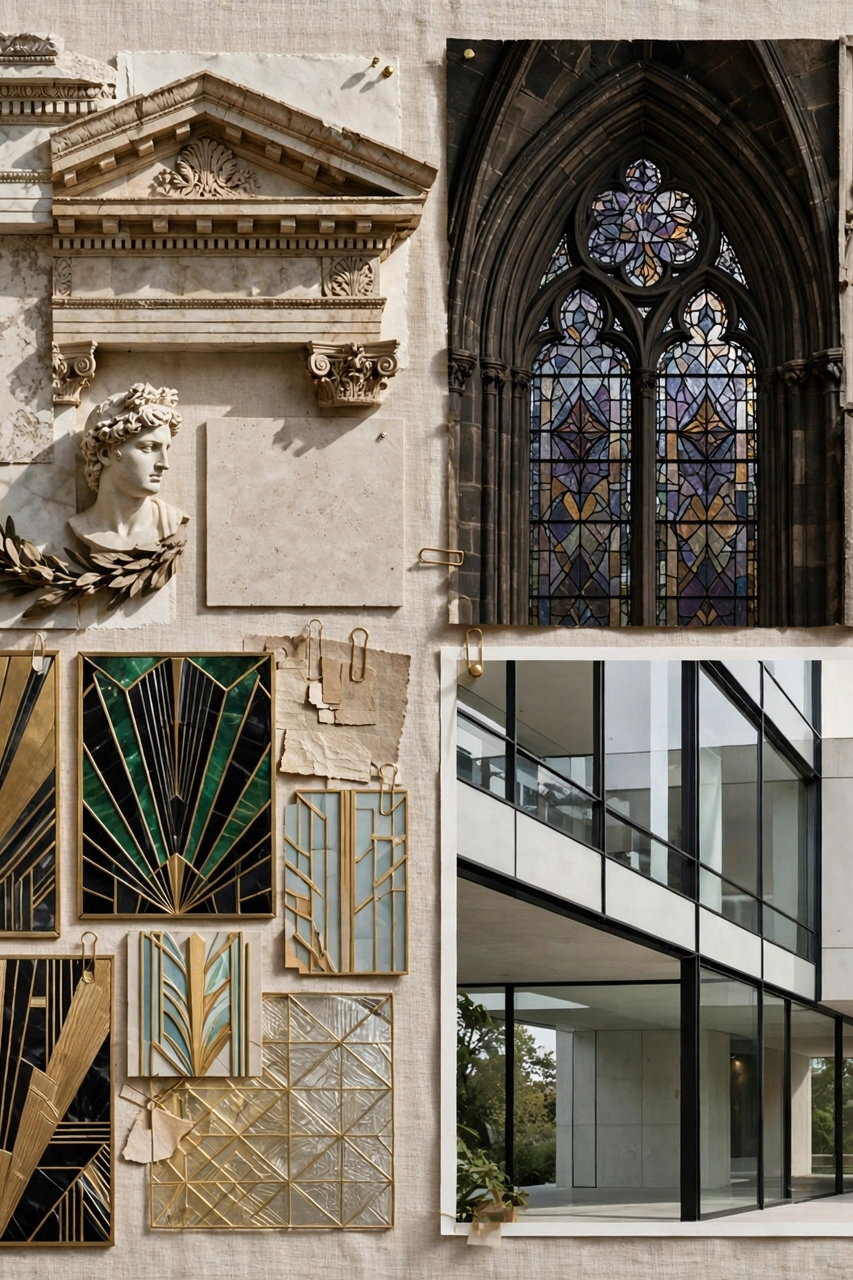
One of the greatest strengths of the Modern Art Deco style is its adaptability. You do not need to live in a 1930s historic building to make this design feel authentic. Here is how to adapt the aesthetic to complement various architectural styles:
The Urban Industrial Loft
- The Challenge: Industrial spaces can often feel cold, raw, and cavernous due to exposed brick, concrete floors, and visible ductwork.
- The Art Deco Solution: Use the style to introduce warmth and deliberate luxury. The soft curves of a plush velvet sofa create a beautiful, striking tension against a rugged brick backdrop. Polished brass fixtures pop spectacularly against matte black industrial steel frames, turning a utilitarian space into a highly sophisticated residence.
The Mid-Century Suburban Home
- The Challenge: Mid-century modern homes emphasize low horizontal lines, wood tones, and open-plan concepts, which can occasionally lean too casual.
- The Art Deco Solution: Focus on the shared love of geometry. Integrate sleek, tubular metal frames, tapered legs with brass caps, and geometric rugs. The introduction of high-gloss lacquer finishes or a deeply saturated jewel-toned accent wall elevates the casual mid-century layout into something decidedly more glamorous and formal.
The Ultra-Minimalist Contemporary Build
- The Challenge: Brand-new construction often features crisp white walls, hidden storage, and sharp angles, which can sometimes border on sterile or lifeless.
- The Art Deco Solution: Treat the minimalist architecture as a pristine art gallery. Bring in a singular, monumental marble plinth coffee table and a dramatically curved sofa. The stark, clean backdrop allows the highly sculpted silhouettes and metallic finishes of your Art Deco fixtures to stand out like curated exhibition pieces.
10. The Longevity of the Aesthetic
Trends come and go with head-spinning speed, often leaving homeowners with spaces that feel dated within a few short years. Modern Art Deco bypasses this cycle because it is rooted in timeless architectural principles: symmetry, proportion, high-quality materials, and structural integrity.
By investing in well-crafted furniture with classic geometric silhouettes, utilizing premium materials like stone, solid timber, and refined metals, and keeping clutter at bay, you create a living space that transcends the fleeting whims of fast interior fashion.
WRAP UP
A Modern Art Deco living room does not scream for attention through loud, disposable novelties. Instead, it commands respect through its poise, its material luxury, and its deep reverence for the home it inhabits. It turns the act of coming home into a daily celebration of art, history, and architectural beauty.